
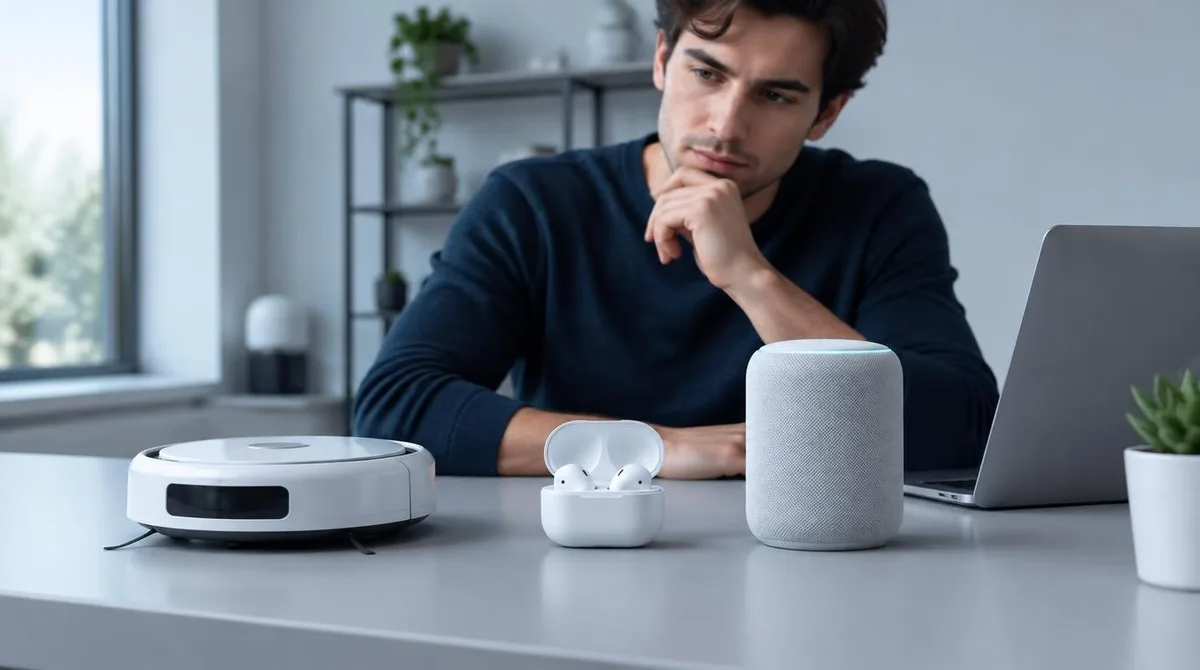
AI gadgets are consumer devices that use artificial intelligence to learn from data, recognize patterns, and adapt their behavior instead of following fixed, pre-programmed instructions. The category now spans phones, headphones, cameras, wearables, home speakers, and robot vacuums. What separates a genuine AI capability from a marketing label is whether the device demonstrably learns or adapts, or simply runs a scripted feature with an AI badge on the box.
The core technology is not mysterious. Artificial intelligence is technology that lets computers simulate human learning, comprehension, problem solving, and decision making, according to IBM. In practice, that means a device can identify objects in a camera feed, understand spoken language, or make recommendations based on what it has observed. Most of those functions run on machine learning models, which are trained on data rather than explicitly programmed for each task.
This explainer covers how AI inside gadgets actually works, which categories have adopted it, and what buyers should check before paying for the label. The honest answer up front: the value depends entirely on which specific capability a device has, and that capability is usually documented by the maker rather than verified by an independent tester.
How does AI inside a gadget actually work?
Most consumer AI runs on a stack of three things: data, algorithms, and computing power. Michigan Technological University lists these as the fundamental components of AI, noting that AI systems need large quantities of information to train effectively and significant computing resources to run complex algorithms. In a gadget, the model is usually trained in advance on servers, then shipped to the device to run on new input.
Two broad families show up in products. Traditional AI analyzes data using rules, algorithms, and historical data to make predictions, which suits precise, repetitive tasks like facial recognition or fraud detection. Generative AI creates new content such as text, images, or audio in response to a prompt, which powers chat features, image editing, and voice assistants that produce original responses. Both approaches appear in consumer hardware, often side by side.
Underneath both sits deep learning, a subset of machine learning that uses multilayered neural networks. IBM notes that some form of deep learning powers most AI applications in daily life, and that it suits tasks like natural language processing and computer vision. That is why the two most common gadget AI features are seeing and listening: object detection in a camera, speech recognition in a speaker or earbud.
Where the model runs matters as much as what it does. Some features process everything on the device, which keeps data local and works without a connection. Others send audio or images to cloud servers for processing. Maker documentation usually states which is which, and that detail often determines latency, privacy exposure, and whether the feature works offline.
Which device categories are using AI?
The spread is broad, and the depth varies. A useful way to sort the market is by what the AI actually does in each category.
- Phones and cameras: computational photography, object and scene recognition, and on-device assistants. These rely on computer vision, which Michigan Tech describes as techniques that help computers understand digital images and video, including object tracking and image classification.
- Wearables: sensors paired with models that interpret heart rate, movement, or sleep patterns and surface recommendations. The intelligence is in the interpretation layer, not the sensor.
- Smart speakers and earbuds: speech recognition and natural language processing, which MTU defines as algorithms that let computers understand text and spoken words. Voice assistants are among the oldest AI features in consumer hardware.
- Home robots: vacuums and mowers that map rooms, detect obstacles, and adapt cleaning or cutting paths. Perception here combines object detection with decision-making systems.
- Generative AI devices: a newer wave of dedicated hardware built around chat and content-generation models, mostly cloud-dependent.
The pattern across categories is consistent: AI handles perception and pattern recognition well, and it handles open-ended judgment less reliably. A vacuum that avoids a pet is a solved pattern problem. An assistant that reliably understands an unusual request is still a work in progress, and buyers should treat claims of general intelligence in a gadget with the same skepticism they would apply to any other spec.
What can these devices actually do, and what can't they yet?
Documented capabilities cluster into four functions. IBM's overview of AI describes systems that can see and identify objects, understand and respond to human language, learn from new information, and make detailed recommendations. Michigan Tech adds problem-solving and perception as core functions, alongside learning and reasoning. Nearly every AI feature in a consumer product maps to one of those.
What they cannot yet do is just as important. A gadget's AI performs the specific tasks it was trained for. It does not reason like a person, and Michigan Tech's own framing makes the distinction: traditional AI works from curated data for specific purposes, prized for precision on repetitive tasks. Generative models can produce fluent text or images, but fluency is not correctness, and a confident wrong answer is still a wrong answer. Devices that lean on cloud models also inherit those models' limits, including dependence on connectivity and the vendor's continued support.
There is also a practical constraint that rarely makes the marketing: running AI takes real compute. That is why on-device features are often narrow, such as one photography model or one wake-word detector, while broad assistant features run in the cloud. Readers interested in the hardware side can see What Actually Makes AI Hardware Fast: GPUs, TPUs, and Matrix Math for how the underlying chips handle this work. Readers following this should also see What Actually Makes AI Hardware Fast: GPUs, TPUs, and Matrix Math.
How should buyers assess an AI gadget's claims?
Because most capabilities are documented by makers rather than independently verified, the burden falls on the buyer to read the documentation critically. A short checklist helps.
- Find the specific capability, not the label. "AI-powered" is not a spec. Look for the named function: object detection, transcription, noise cancellation, route mapping. If the maker cannot name what the model does, the label is doing the work.
- Check where processing happens. On-device versus cloud changes privacy, latency, and offline behavior. Documentation usually states this.
- Separate traditional from generative. A recognition feature trained for one purpose tends to be reliable. A generative feature produces new content and can be confidently wrong. The two deserve different levels of trust.
- Ask what data trains the adaptation. If a device claims to learn from you, the documentation should say what it collects and where it goes. Learning claims without a data explanation are pitch language.
- Look for named evaluations. Where a maker cites a benchmark, check who ran the test and on what. Benchmark claims deserve the same scrutiny as any other number; see How AI Benchmarks Actually Work and Where They Mislead.
None of this means AI gadgets are a bad buy. It means the category is a bundle of very different capabilities sold under one word, and the word carries no information on its own.
What this means for the market
Our analysis: the AI gadget market is maturing in two directions at once. Narrow, trained-for-purpose features, such as camera recognition, voice control, and obstacle avoidance, are becoming standard because they work reliably. Broad, generative features are spreading faster than their reliability justifies, carried by the same pitch energy that surrounds generative AI generally. IBM notes that in 2024 most AI attention focused on generative AI, and gadget marketing has followed that attention.
The durable takeaway is simple. Judge an AI gadget by its documented capabilities, its processing location, and its data practices, not by the acronym on the packaging. The devices that keep their value after the novelty fades will be the ones whose AI does one specific job well, day after day, without requiring the buyer to trust a claim the documentation does not support.