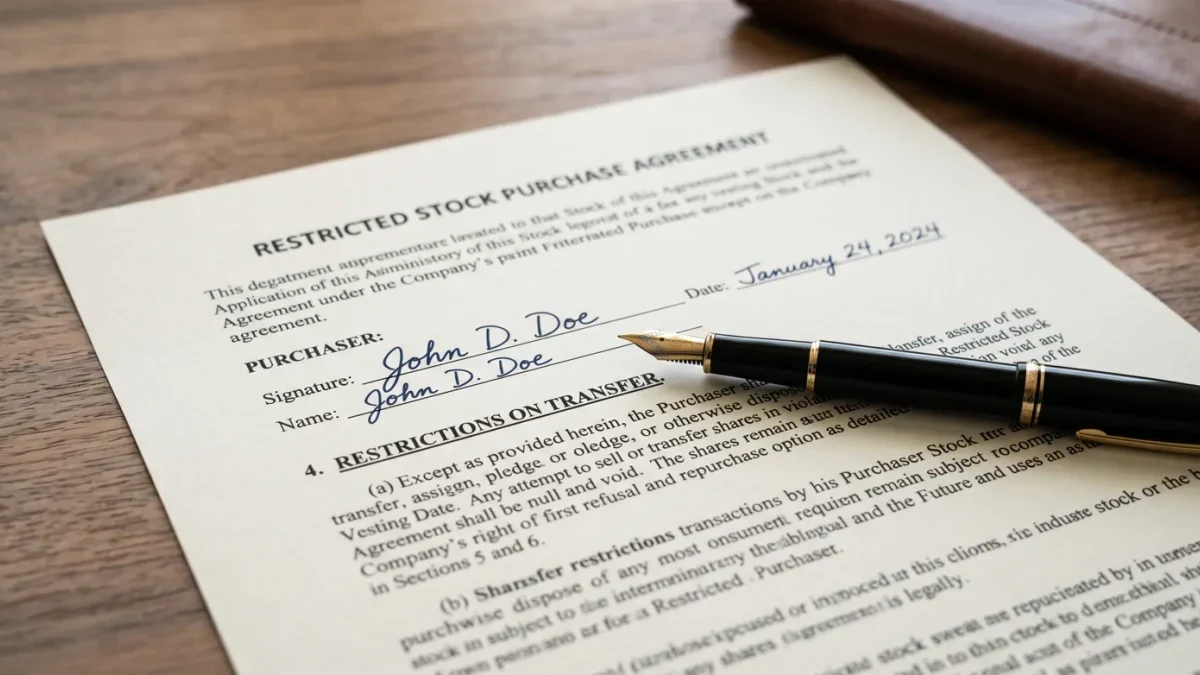

Founder vesting is the schedule under which a founder earns equity over time instead of owning it outright; the standard is four years with a one-year cliff: nothing vests for twelve months, a quarter vests at the anniversary, the rest follows monthly. Cooley's guidance documents these mechanics as market practice, answering what happens to a departing founder's equity.
What is vesting, mechanically?
Vesting is a restriction on stock ownership: the founder holds shares from the start, but the company retains the right to repurchase any shares that have not yet vested, at the lower of original cost or current fair market value, if the founder stops providing services. Per Cooley GO's founder basics guide, under a typical vesting schedule, the stock vests in monthly or quarterly increments over four years, and there is often a one-year cliff meaning the individual must be with the company for a year to vest the first increment.
The repurchase right is what gives the mechanism teeth. Without vesting, a co-founder who departs in month three keeps their full stake forever; with vesting, the company buys back the unvested shares for what was paid for them — typically a fraction of a cent — and the remaining founders' ownership of the company is restored. The departed founder keeps only what vested.
For founders, unlike employees, vesting is usually imposed retroactively at the first priced financing: investors routinely require founders to accept a four-year schedule starting from the financing date, sometimes with credit for time already served. A founder signing one of these agreements is, in effect, re-earning a large share of the company they founded.
Why would founders vest their own equity?
Because investors fund teams, not cap tables. A venture investment priced on the assumption that a founding team will work for years becomes mispriced the moment half that team departs with half the equity. Founder vesting aligns the incentive: the people holding the majority of the company are the people still building it.
The arrangement also protects the founders who stay, which is the part first-time founders most often miss. In a two-person startup with a 50-50 split and no vesting, one departure leaves a ghost shareholder controlling half the company — someone with no obligation to the company and every reason to hold out in a future acquisition. Vesting removes that scenario before it exists.
Investors are not disinterested here, and founders should read the term as a negotiation rather than a formality. The variables worth negotiating are the total duration, the cliff length, credit for time served before financing, and what counts as a triggering departure — for example, whether termination without cause accelerates rather than forfeits vesting.
How does the standard schedule work in numbers?
The arithmetic of the standard schedule is simple and worth memorizing, because it determines what a departing founder at any month of a company's life actually walks away with.
| Point in schedule | Share of grant vested |
|---|---|
| Months 0-11 | 0% (pre-cliff) |
| Month 12 (cliff) | 25% vests at once |
| Months 13-48 | Remainder vests in equal monthly or quarterly increments (e.g., 1/36 per month) |
| Month 48 | 100% vested |
Under monthly vesting after the cliff, each month from month 13 onward adds one thirty-sixth of the grant. A founder leaving at month 20 has vested 25% plus eight monthly increments; the company may repurchase the rest at cost. Employees typically receive the same structure applied to stock options, where each vested increment becomes exercisable rather than issued.
Vesting schedules can also be longer — later-stage companies and some acquirers extend founders to five or six years — and cliffs can be negotiated away in exchange for other terms. But the four-year, one-year-cliff shape remains the default that any deviation must be argued against.
What happens to vesting when the company is sold?
An acquisition collides with an unvested schedule, and the resolution is an acceleration clause negotiated into the original agreement. Two forms exist. Single-trigger acceleration vests some or all remaining shares upon the acquisition itself. Double-trigger requires two events: the acquisition, and the founder's termination without cause — or resignation for good reason — within a defined window after closing. Cooley's guidance describes the double-trigger form as one that accelerates the vesting of any unvested shares if the company is sold and the employee is terminated without cause within some time period following the closing.
Acquirers generally dislike single triggers, because they buy teams as much as technology and a fully accelerated pool removes the retention lever. Double triggers have become the common compromise: the founder who is pushed out is protected, while the founder who stays joins the acquirer's retention plan like other employees. Founders negotiating acceleration should expect the double-trigger form with a 12-to-24-month post-closing window as the market standard.
The absence of any acceleration clause is also a negotiated outcome, not an oversight — plenty of founder agreements have none, leaving unvested shares to be handled case by case, or by the acquirer's retention package, at the time of a sale.
What is the 83(b) election, and why is the clock short?
Section 83(b) of the U.S. Internal Revenue Code lets a founder elect to treat restricted, unvested shares as vested immediately for tax purposes. Cooley's guide to the election states the mechanics: within 30 days of grant the taxpayer can file an election with the Internal Revenue Service to treat the unvested or restricted property as vested immediately at the time of grant, including the shares' fair market value in income and paying the corresponding tax then. Without the election, each vesting tranche is taxed as ordinary income at its value on the vesting date.
The reason the election matters is timing. At founding, shares are typically worth fractions of a cent, so the tax on a full grant is negligible; at each later vesting date, the shares may be worth dramatically more, taxed at higher ordinary-income rates. The election converts years of future ordinary income into one small immediate payment and starts the long-term capital gains holding period on day one.
The deadline is unforgiving, which is why it deserves its own checklist:
- File the written election with the IRS within exactly 30 days of the stock grant — no extensions, no exceptions for missed mail.
- Send a copy to the company and keep proof of mailing and delivery with the corporate records.
- Attach the election to that year's personal tax return.
- Confirm every co-founder has done the same, since the election is individual.
A missed 83(b) is among the few genuinely unfixable mistakes in startup finance: the default taxation applies, and no later filing can restore the election. Founders who understand vesting, acceleration, and this thirty-day window hold the full mechanics of their own equity — which is the minimum equipment for negotiating any of it.
What should founders check in their own vesting agreements?
Because the terms look boilerplate and are not, a short audit of any founder vesting agreement pays for itself. The checklist, in the order disputes usually arise:
- Start date of the schedule — from company founding, from a specified earlier date, or from the financing that imposed it.
- Cliff length and credit for time already served, which together determine what a departure in year one actually costs.
- Vesting frequency after the cliff — monthly is standard and quarterly is common; the difference matters in a mid-year departure.
- Definition of a termination for cause versus without cause, since the definition controls both forfeitures and any acceleration.
- Acceleration clause, if any: single or double trigger, percentage accelerated, and the post-closing window.
- Repurchase mechanics: price formula, who exercises, and any transfer restrictions on vested shares.
Each item is a term a lawyer can negotiate in an afternoon and a founder can live with — or regret — for the life of the company. The pattern across startup post-mortems is consistent: equity disputes between founders rarely involve dishonesty; they involve standard documents whose mechanics nobody re-read carefully while everyone still got along.