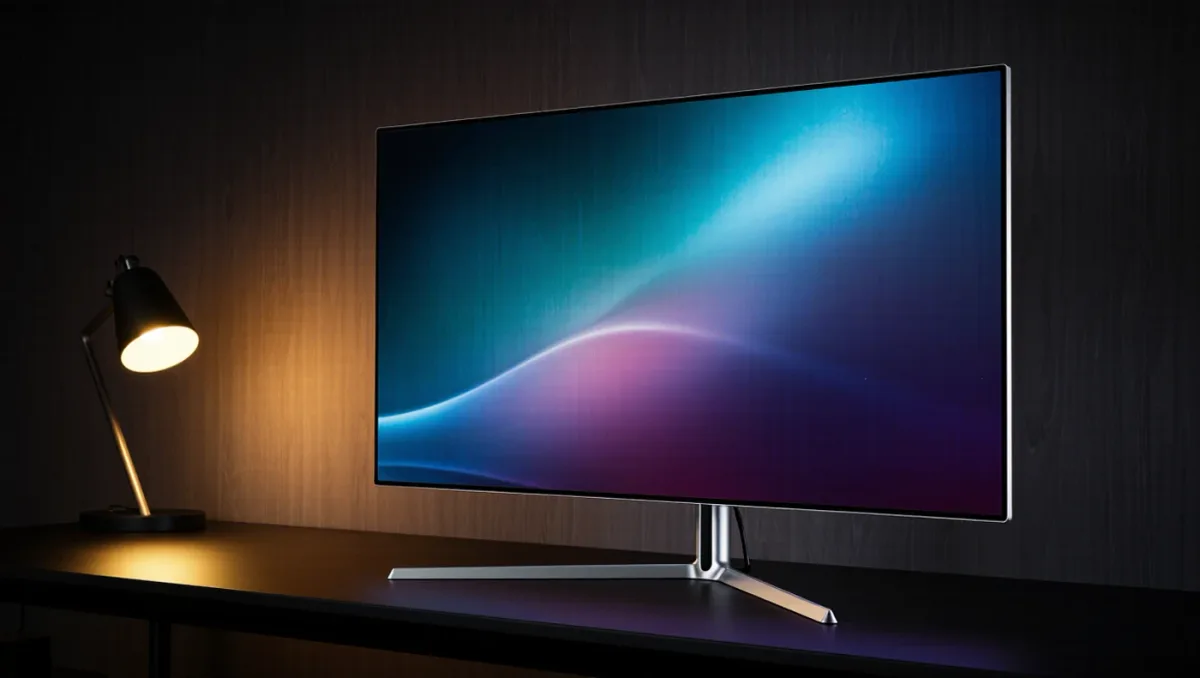
QD-OLED is a display technology that pairs OLED's light-emitting pixels with quantum dot color conversion, and its newest generation changed the pixel's geometry. Samsung Display announced on January 1, 2026 that it had begun mass production of the world's first 34-inch 360 Hz QD-OLED panel using a V-Stripe structure aligning red, green, and blue sub-pixels vertically.
What is a sub-pixel, and why does its shape matter?
Every pixel on a color display is built from smaller sub-pixels — one red, one green, one blue — and the geometry of that trio decides how sharply a panel renders edges. Samsung Display's announcement explains that its V-Stripe structure, developed independently for the company's quantum dot elements, improves the clarity of text edges, making the panels suited to text-intensive work such as document editing, coding, and content creation. TechPowerUp's January 1, 2026 report carries the same detail: the vertical RGB alignment shifts from the conventional triangular sub-pixel arrangement used in current QD-OLED technology.
The reason is rendering arithmetic. Text is the hardest content for any panel because letterforms are thin, high-contrast edges drawn at arbitrary angles. How those edges cut across sub-pixel boundaries determines whether a glyph looks crisp or fringed, and a regular vertical stripe gives display drivers a more predictable pattern to work with than a staggered triangle. Monitor makers have exploited sub-pixel geometry for years with font rendering; changing the physical layout raises the ceiling of what that rendering can achieve.
What are the panel's documented specifications?
Per TechPowerUp's report on the official announcement, the new panel combines a 21:9 ultra-wide aspect ratio, a 360 Hz refresh rate, and peak brightness of 1,300 nits. Samsung Display states it has been supplying the panels to seven global monitor manufacturers — including ASUS, MSI, and Gigabyte — since December 2025, and separately notes it held a leading 75 percent share of the monitor OLED panel market in 2025, a company-claimed figure.
| Specification | Documented value (Samsung Display, Jan 1, 2026) |
|---|---|
| Panel size / aspect | 34-inch, 21:9 ultra-wide |
| Refresh rate | 360 Hz |
| Peak brightness | 1,300 nits |
| Sub-pixel layout | V-Stripe vertical RGB (vs. triangular) |
| Supply partners | Seven monitor makers incl. ASUS, MSI, Gigabyte |
All figures above come from the maker's announcement and should be read as company-claimed until independent measurements of shipping monitors appear; brightness in particular depends on the measurement window and the content on screen.
Why was a 360 Hz ultra-wide hard to build?
Bandwidth and heat. In its announcement, Samsung Display explains that compared with a 16:9 display, a 21:9 aspect ratio generally increases the number of horizontal pixels and the volume of data processed, producing higher power consumption, greater heat generation, and increased operational demands even at the same refresh rate. Maintaining uniform signal timing across left and right pixels is also technically challenging, the company states, which is why high refresh rates on ultra-wide panels have lagged their 16:9 siblings.
That timing problem is the quiet engineering story under every headline refresh-rate number. A panel is a grid driven row by row; stretching the rows wider makes the electrical delays across each row harder to equalize, and any skew shows up as artifacts at the screen's edges. Solving it at 360 Hz in a 34-inch form factor is what made this generation notable rather than incremental — the kind of constraint that is invisible in a spec sheet until it is the reason a rival panel does not exist yet.
How does QD-OLED relate to other display technologies?
Within OLED, competition is now organized around sub-pixel architecture as much as brightness. The previous QD-OLED generation used a triangular arrangement; V-Stripe moves to vertical RGB stripes. Rival LG Display has pursued its own RGB sub-pixel developments for OLED panels, as TechPowerUp's coverage of the January announcement notes, so sub-pixel geometry has become the ground where panel makers differentiate — a shift from the pure brightness race of earlier generations.
The QD-OLED approach itself sits between two older camps. Traditional white-OLED televisions use white emitters with color filters, sacrificing some efficiency for manufacturing simplicity. Samsung's design drives blue OLED light through quantum dot layers that convert it to red and green, trading a more complex stack for better color performance. V-Stripe changes how those converted sub-pixels are arranged, not how they emit — an evolution of layout rather than chemistry.
It is also a reminder that panel progress is now architectural rather than material. The emitters, the quantum dot layers, and the drive electronics are all mature ingredients; what changes between generations is how those ingredients are arranged — sub-pixel geometry, pixel density, the electronics that keep wide grids timed. Buyers evaluating competing panels should therefore compare the layout and its documented consequences, such as text clarity, rather than generation labels alone, because the labels describe marketing years, not capabilities.
What should buyers take from all this?
Workload-dependent translation, as always with panels. Competitive gamers benefit from the 360 Hz refresh rate, provided their graphics hardware can actually feed it at the panel's resolution. Content creators benefit from the text clarity of the new sub-pixel layout and the color performance QD-OLED is known for. General users get both, provided the monitors carrying the panel — the first from ASUS and MSI — price sanely against established 240 Hz ultra-wides.
Two cautions apply. Specifications describe the panel, and reviews of finished monitors will describe the experience, which includes firmware, coatings, and thermal management that vary by brand. And first-generation layouts sometimes carry quirks — rendering artifacts in particular applications — that only surface once thousands of users install the screens. The specification table is the starting point of a buying decision, never the end of one.
How can a reader verify any monitor claim before buying?
Display marketing stretches fewer truths than it used to, but the burden of verification still sits with the buyer. A short discipline works for any panel technology:
- Find the figure in the panel maker's official announcement or spec sheet, not the monitor brand's marketing page — brands quote peak numbers that the panel achieves only in specific modes.
- Check the measurement conditions for any brightness figure, since peak brightness on a small window differs from full-screen sustained brightness.
- Look for at least one independent measurement of a shipping monitor before paying a premium for a first-generation panel.
- Confirm the interface chain supports the claim — a 360 Hz panel needs a cable, connector, and graphics output that carry that bandwidth.
The V-Stripe generation will get its independent measurements soon enough, because that is how monitor journalism works: the panel maker announces, the brands ship, and the test rigs answer. Until then, the documented specification table above is exactly as strong as its sourcing — an official announcement, quoted accurately, with its company-claimed status attached.