Connectivity standards are the published specifications that let any maker's cable, router, or earbuds work with any other maker's device, and three consortia write most of them: the USB Implementers Forum, the Wi-Fi Alliance, and Bluetooth SIG. Their version numbers are capability tiers. Wi-Fi CERTIFIED 7, introduced January 8, 2024, doubled channel width to 320 MHz and added Multi-Link Operation.
Who writes connectivity standards, and how?
A connectivity standard is a technical document that defines connectors, signaling, protocols, and behavior precisely enough that two implementations by different companies interoperate. They are written by industry consortia — groups of member companies that contribute engineering time and agree on the specification by committee. USB's specifications come from the USB Implementers Forum and its Promoter Group; Wi-Fi's from the Wi-Fi Alliance in coordination with the IEEE 802.11 working group; Bluetooth's from Bluetooth SIG.
The process is slow by design. A draft specification circulates among members, gets commented on, is tested in plug fests where engineers physically connect prototype hardware, and is eventually ratified and published. Only after publication does certification begin, and certification is the part consumers actually touch: a device carrying the Wi-Fi CERTIFIED or Bluetooth marks has passed a test suite at an authorized lab, against a test bed of other members' equipment.
Regulators occasionally step in on top of the standards rather than inside them. The clearest recent case is the European Union's common charger directive, under which — as the European Commission stated when the rules began applying on December 28, 2024 — all new devices sold in the EU must now support USB-C charging. The EU did not write the USB-C specification; it mandated that a consortium specification be used.
What is USB-C, beyond the connector shape?
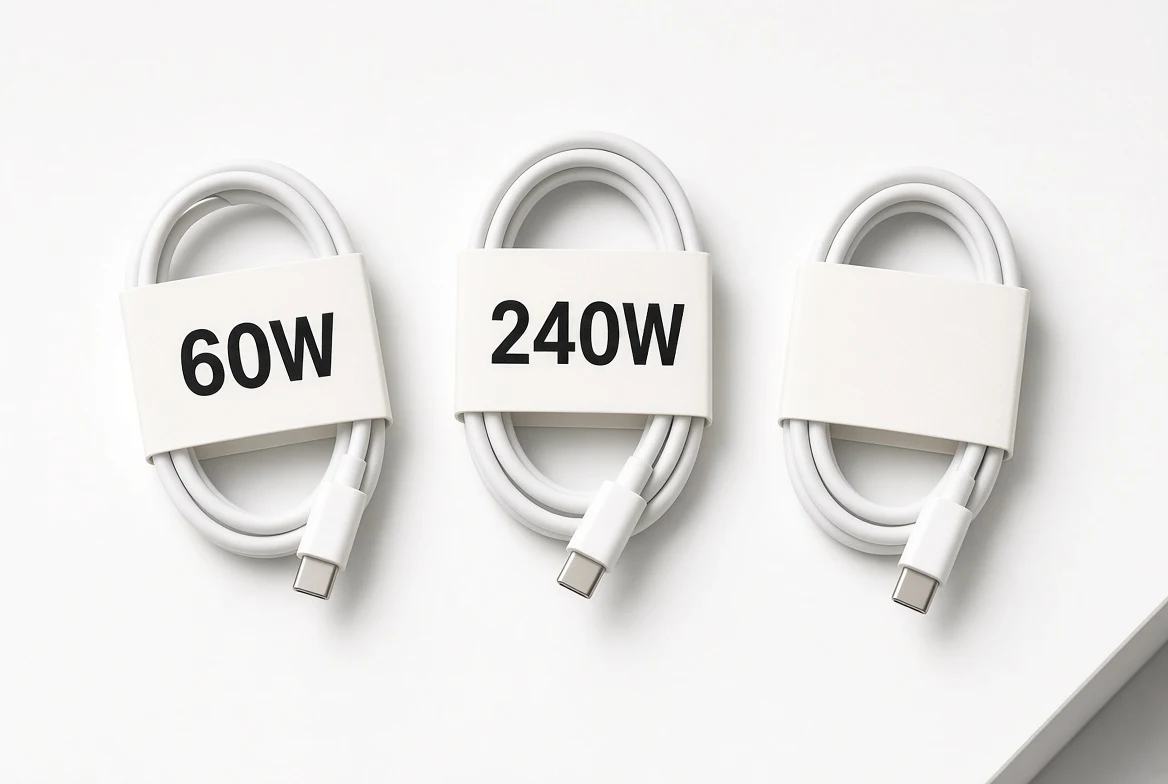
USB Type-C is a connector and cable specification: 24 pins, reversible, rated for the mechanical wear of daily plugging. What runs across those pins is a stack of separate specifications, which is why two identical-looking cables can behave completely differently. Data may run at USB 2.0's 480 Mbps or at the tens of gigabits per second of newer USB4 generations; power delivery is negotiated separately, up to 240 W under the USB Power Delivery specification; and the connector also carries alternate modes, where the pins carry another protocol entirely, such as DisplayPort video.
This layering is the source of nearly all consumer confusion. The shape guarantees the plug fits; it guarantees nothing about speed, charging rate, or video support, because those are separate specs a manufacturer chooses among. A charging-only cable and a full-featured USB4 cable share a connector and little else.
The EU mandate made USB-C the default charging port across phones, tablets, cameras, headphones, headsets, portable speakers, e-readers, keyboards, mice, portable navigation systems, and earbuds sold in the EU, with laptops required to follow from April 28, 2026, per the Commission's announcement. The practical effect was to collapse a drawer of proprietary cables into one — and to make the spec tiers behind the shared connector the remaining thing to check.
What does Wi-Fi 7 actually add?
Wi-Fi 7 is the certification generation built on the IEEE 802.11be standard, and its features are enumerated in the Alliance's certification materials rather than in marketing copy. The Wi-Fi Alliance's launch release lists the concrete additions: 320 MHz channels that double today's widest channel size, Multi-Link Operation, 4K QAM modulation, and a set of efficiency features for scheduling and overhead reduction.
| Wi-Fi 7 feature | What it does |
|---|---|
| 320 MHz channels | Ultra-wide channels, available where the 6 GHz band is open to Wi-Fi, to enable multigigabit device speeds |
| Multi-Link Operation (MLO) | Devices transmit and receive over multiple links simultaneously for higher throughput, lower latency, better reliability |
| 4K QAM | 20% higher transmission rates than the previous 1024 QAM modulation |
| Multiple RUs to a single station | More flexible spectrum scheduling, improving efficiency in crowded bands |
Multi-Link Operation is the structural change. Earlier Wi-Fi generations picked one channel and stuck with it; MLO lets a device use 2.4, 5, and 6 GHz links at once, aggregating throughput and rerouting around interference. The 6 GHz dependency matters too: where the band is not opened to Wi-Fi, several of the headline features are unavailable, which is why the same certified router behaves differently in different regulatory regions.
How does Bluetooth differ from the other two?
Bluetooth is a personal-area standard: short range, low power, and organized around pairing relationships rather than networks. It maintains two radios in one stack — Classic, the original audio-and-data mode, and Bluetooth LE, the low-energy mode used by fitness trackers, smart tags, and sensors. Recent generations added LE Audio with Auracast broadcast audio and Channel Sounding, a ranging feature that lets paired devices estimate distance between them.
Its governance mirrors the other consortia: Bluetooth SIG members write the Core Specification, and products carry the Bluetooth marks after qualification testing. The differences from USB and Wi-Fi are scope and power budget: a Bluetooth device is designed to run for months on a coin cell, which shapes every protocol decision in the specification.
What does certification actually guarantee?
Certification guarantees interoperation with other certified equipment, not performance. A Wi-Fi CERTIFIED 7 badge means the device passed the Alliance's test bed — which at launch included silicon from Broadcom, Intel, MediaTek, Qualcomm, and others — against the defined feature set. It does not mean the device achieves any particular speed in a particular home, because walls, distance, and the client device on the other end dominate real throughput.
For a buyer, the practical decoding of any spec sheet is therefore three questions. Which certification generation does each device carry, on both ends of the link? Which optional features within that generation did the maker actually implement — 320 MHz support and MLO are per-product choices, not obligations? And in the USB case, what does the specific cable, not just the connector, support for data, power, and video? Standards make compatibility checkable; they leave the checking to the reader.
Why do version numbers cause so much confusion?
Because the marketing names and the engineering names diverged. Wi-Fi's generational labels — Wi-Fi 5, 6, 7 — are the Alliance's consumer names layered on top of IEEE's 802.11 designations, so a router box may carry either or both. USB's branding has fragmented further: the same connector carries USB 2.0, USB 3.2 generations with overlapping names, and USB4 tiers, and a cable's box may state a speed, a generation number, or both. Bluetooth's version numbers refer to Core Specification releases, whose headline features — LE Audio, Auracast, Channel Sounding — ship as options a manufacturer chooses to implement.
The underlying cause is structural: consortia publish capability tiers, and manufacturers pick the subset their product's cost target allows. A standard specifies what is possible and testable, not what any given device includes. That is why certification marks list tested features individually rather than affirming a whole generation wholesale.
The reader's defense is to treat the version number as a ceiling, not a promise. A Wi-Fi 7 laptop supports at most what Wi-Fi 7 defines; what it supports at minimum depends on which features its maker certified, and the certification directory — not the box copy — is the document that settles it.
How fast do these standards actually move?
On roughly four-to-six-year cycles for major generations, with incremental revisions between. The Wi-Fi Alliance introduced its Wi-Fi 7 certification in January 2024, years after the IEEE draft process began and before every regulator opened the 6 GHz band the specification leans on. USB's Type-C connector shipped in 2014 and its USB4 80Gbps tier followed later, with the same connector carrying each step. Bluetooth's Core Specification moves on a similar cadence, with feature options landing between major releases.
The lag between specification and experience is normal and worth expecting: a standard's publication date marks when interoperation testing could begin, not when the feature reaches a given shelf. Between a specification's ratification and a typical household owning two certified ends of the link, several product cycles usually pass — which is why the standards that matter most in practice are usually the ones certified two or three generations before the device being shopped for today.