
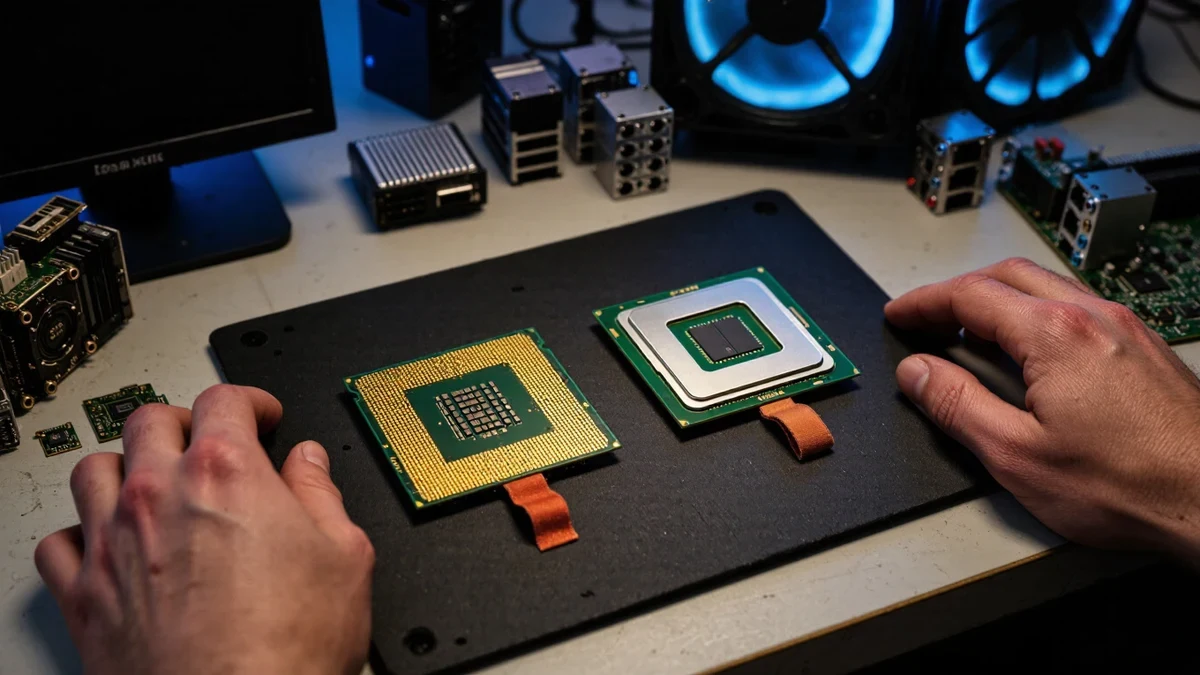
AMD committed to a strategic equity investment of up to $5 billion in Anthropic alongside a deal to deploy up to 2 gigawatts of Instinct MI450 GPUs, with the first gigawatt starting in the first half of 2027 (announced, AMD press release, July 22, 2026). Chips, cash, and software in one package is now the standard deal shape.
What did AMD and Anthropic actually announce?
Three linked commitments. Anthropic deploys AMD Helios rack-scale systems featuring Instinct MI455X GPUs with EPYC "Venice" CPUs, Pensando networking, and ROCm software; the two companies run a multi-year engineering collaboration using Claude to optimize workloads for Instinct GPUs and accelerate ROCm development; and AMD commits an equity investment of up to $5 billion in Anthropic (all announced, AMD's press release).
The deployment builds on Anthropic's existing use of AMD Instinct MI355X GPUs, so this is an expansion of a working relationship rather than a first bet. AMD also stated it will broadly adopt Claude across its engineering and product development teams — the kind of customer-commitment clause that makes these deals reciprocal rather than one-directional.
Every figure here carries its label: the gigawatts, the timeline, and the investment ceiling are company announcements, not independently verified deployments. The ceiling matters — "up to" $5 billion and "up to" 2 gigawatts define maximum commitments, not delivered capacity, and deployment of the first gigawatt is dated to the first half of 2027.
What is being exchanged in deals like this?
Compute, capital, and credibility, moving in both directions. The AI lab gets a guaranteed hardware pipeline at gigawatt scale; the chipmaker gets a flagship customer for a new rack platform, an equity position in one of the most-watched AI companies, and its own engineers using the customer's product daily.
The same pattern appears across 2026's partnership wave. Microsoft announced on July 15, 2026 that Azure will become the first announced hyperscale cloud provider to deploy 3M's Expanded Beam Optical technology, with the companies combining hyperscale infrastructure and materials science to accelerate AI adoption (announced, Microsoft's announcement). The currency differs — optical interconnect instead of GPUs — but the architecture of the deal is identical: an infrastructure supplier and an AI-scale buyer locking themselves together.
| Deal | Announced | What is exchanged |
|---|---|---|
| AMD–Anthropic | July 22, 2026 | Up to 2 GW MI450 compute; up to $5B equity; Claude used in AMD engineering |
| Microsoft–3M | July 15, 2026 | 3M Expanded Beam Optical deployed in Azure; 3M adopts Microsoft AI tools |
Notice what is missing from both columns: prices. Partnership announcements almost never disclose what the hardware costs or what the equity buys — those terms live in contracts nobody publishes, which is why the announced quantities, dates, and ceilings are the only hard public data in the story.
Why are equity-plus-compute packages becoming the default?
Because each side's biggest risk is the other side's commitment. Building rack-scale platforms like Helios only pays if anchor customers absorb volume for years; training frontier models only works if compute arrives on schedule. An equity stake aligns incentives in a way a purchase order cannot, and a software collaboration — Claude optimizing ROCm workloads — turns the customer into a co-developer of the platform it depends on.
There is also a competitive read. A second major AI lab anchored on non-Nvidia silicon at gigawatt scale strengthens AMD's position in AI infrastructure, and AMD framed the deal as a major expansion of its role in the global AI buildout. That framing is the company's own; the verifiable facts are the announced capacity, the investment ceiling, and the H1 2027 start for the first gigawatt.
For buyers and developers, the practical consequence is ROCm's trajectory. If a frontier lab's engineers are formally tasked with optimizing workloads for Instinct GPUs, the software gap that historically favored incumbents gets sustained engineering hours pointed at it — a benefit that spills over to every other Instinct customer.
What happens to smaller buyers in this market?
They inherit the platforms the giants de-risk. Rack-scale systems engineered for gigawatt anchor tenants eventually compress into the cloud instances and server SKUs ordinary companies rent. That is the historical pattern of every compute wave — mainframes, x86 servers, hyperscale clouds — and there is no sign this one differs.
There is a second-order effect worth naming: standards. When a frontier lab commits engineering effort to another company's software stack — as this deal does for ROCm — the tooling, documentation, and bug fixes accumulate in public repositories and vendor releases that every smaller user consumes for free. The announcement prices hardware, but the collaboration quietly funds an ecosystem.
The risk for smaller buyers is schedule and priority. When capacity is contracted years ahead by anchor customers, spot availability tightens and pricing power concentrates. Buyers shopping for 2027 capacity are effectively queuing behind deals like this one, which is why procurement teams now read chip partnership announcements as market intelligence rather than vendor news.
How should readers evaluate the next announcement?
Strip the press release to its committed quantities and ask four questions:
- Is the number a ceiling or a floor? "Up to 2 gigawatts" and "up to $5 billion" bound the maximum, not the minimum.
- When does delivery start? Here, the first gigawatt begins in H1 2027 — a dated, checkable milestone.
- Is money moving, or only intentions? Equity investments and purchase commitments are stronger signals than memoranda of understanding.
- Who is whose customer? Two-way adoption (Anthropic on AMD silicon, AMD on Claude) signals operational integration, not just marketing.
Partnership announcements are planning documents. The buildout they describe will be verified — or quietly revised — by what gets energized in 2027, and by whether the "up to" figures harden into contracted capacity. Until then, the honest ledger records a ceiling, a schedule, and two companies that just made their futures unusually easy to audit.