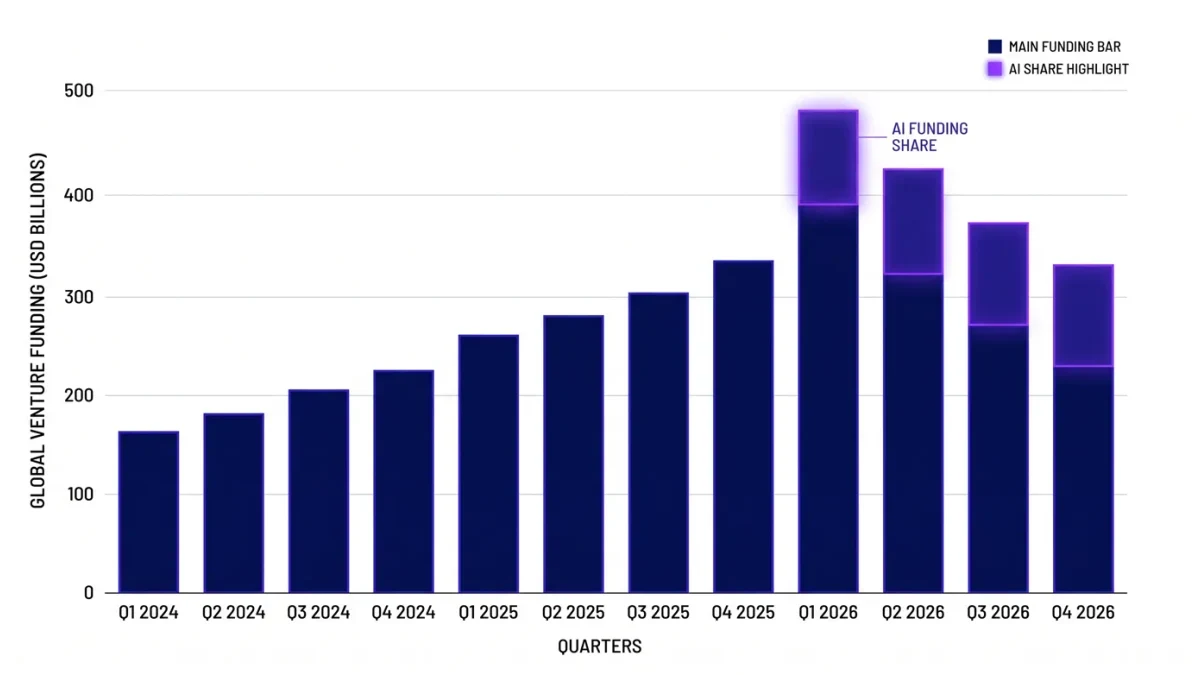

Global venture funding reached $300 billion in the first quarter of 2026, with AI companies taking $242 billion — 80 percent of the total — and four firms drawing nearly 65 percent of all venture investment (Crunchbase data, reported May 27, 2026). In a market that concentrated, milestone announcements measure the giants more than the median startup.
What do milestone announcements actually signal?
A verified commitment, not an accomplishment. When AMD announced on July 22, 2026 that Anthropic would deploy up to 2 gigawatts of Instinct MI450 GPUs, with the first gigawatt starting in the first half of 2027, the verifiable content was the announcement itself: a dated, company-issued commitment with ceiling figures and a schedule (announced, AMD's July 2026 announcement).
Milestones come in grades of hardness. A regulatory filing is hardest — it carries legal exposure. A signed deployment agreement is softer but contractual. A press-release milestone is softest of all: real information about intent and confidence, but self-graded. The reader's job is to identify which grade they are holding before deciding what it proves.
None of this makes announcements worthless. Capacity commitments reshape supplier order books and competitor planning the moment they are made. But a 2027 deployment announced in 2026 is a plan with a date — its truth arrives with the hardware, and its ceiling words bound the promise from above.
Why does concentration change how milestones read?
Because when four companies absorb most of the capital, most milestones belong to a handful of firms rather than a broad market. The Crunchbase-reported Q1 2026 figures describe an ecosystem where the median startup's announcement competes for attention against nine- and ten-figure commitments from a few names.
Concentration also flattens signal diversity. If the same four firms anchor the quarter's biggest rounds, deployments, and partnerships, then aggregate milestone volume tells you about their strategies, not about the health of startups as a class. Analysts reading "AI milestones hit a record" headlines should ask whose record, funded by whom.
For founders outside the giants, the practical consequence is that milestone announcements work best when they carry verifiable specifics — a filing, a named customer, a shipped capability — rather than superlatives that the mega-rounds will always outbid. Specifics age into evidence; superlatives age into noise.
The concentration also changes the audience. When capital pools around four firms, the readers who matter for everyone else's milestones are customers and acquirers, not venture investors — a buyer deciding between vendors cares about shipped capability and uptime, not funding tiers. The most useful milestone press release of this cycle may be the plainest one: what works now, for whom, since when.
Employees read milestones too. Retention packages, project staffing, and hiring plans inside the giant four are set by the same announcements outsiders skim; an internal team learns whether its roadmap is funded from the same press release the market does. Concentration makes milestone literacy an operational skill, not just an investor habit.
How should a reader evaluate the next big announcement?
A four-step filter, applied in order:
- Find the label: announced, filed, company-claimed, or independently verified — the same figure changes meaning with each.
- Find the ceiling word: "up to" bounds the maximum; committed floors, where stated, bound the minimum.
- Find the date: a milestone without a calendar date is a mood, not a plan.
- Find the payer: who spends, who receives, and whether money or only intentions move.
Applied to the AMD–Anthropic example: announced (label), up to 2 gigawatts and up to $5 billion (ceilings), first half of 2027 (date), AMD as investor and Anthropic as deployer (payers). The filter does not judge the deal — it makes the deal's actual shape legible before anyone decides whether to be impressed.
Do milestones still predict anything?
They predict engineering and procurement activity better than they predict success. A company that announces a dated, ceiling-bounded capacity commitment has, at minimum, bound its own schedule to a public fact it will be held to — which is why sophisticated announcers choose their dates carefully and why the absence of any date in a milestone press release is itself information.
Milestones also predict follow-on behavior. Capacity commitments of this scale attract suppliers, local permitting fights, grid interconnection requests, and competitor responses — each of which generates its own verifiable paper trail long before the original promise is fulfilled. Readers who want ground truth can follow the paper, not the press release.
What milestones cannot do is certify outcomes. Deployment ceilings can be revised, first gigawatts can slip, and equity commitments can phase in on conditions. The record to trust is the one with dates attached and checkable events behind them.
A useful symmetry: milestone announcements are also commitments the issuer cannot easily retract. A public, dated capacity promise creates a yardstick for journalists, competitors, and customers — which is why the strongest announcements tend to come from parties already confident in their engineering schedule, and why vague milestones deserve proportionate skepticism.
What does the milestone economy reward next?
Verification. As AI commitments grow to infrastructure scale — gigawatts, multi-year buildouts, national policy entanglement — the announcements that matter are those attached to deliveries: data centers energized, capacity contracted, filings signed. The Q1 2026 concentration means a few firms' execution decisions will dominate the next several quarters of headlines.
The disciplined read is unchanged from any cycle: money as data, labeled and dated; plans distinguished from plants; and enthusiasm never doing the work of evidence.