
The accessory market around every phone and laptop runs on two standards bodies: the USB Implementers Forum, whose USB4 Version 2.0 specification enabled USB 80Gbps over Type-C when published October 18, 2022 (announced), and the Wireless Power Consortium, which certified its first eight Qi2.2 25-watt chargers on July 15, 2025 (announced). Together they define what compliant accessories can do.
Why do accessory ecosystems need standards bodies at all?
A phone maker controls its own port and coil, but it cannot control the thousands of third-party factories building cables and chargers. Standards bodies fill that gap: they write the technical specification, run compliance testing through approved labs, and license certification logos that signal a product has actually passed. The USB Implementers Forum administers the USB4, USB Type-C and USB-C trademarks and compliance programs; the Wireless Power Consortium, an open standards development group of over 300 members, does the same for Qi wireless charging.
The economic function is trust at volume. A certified accessory works across every compliant device, so a charger maker can sell one SKU to the entire market rather than one per phone brand — and buyers can treat the logo, rather than the brand name, as the compatibility contract. When certification fails or is skipped, the same market fills with under-specced cables and misaligned chargers, which is the problem the system exists to prevent.
The two bodies also police language, which matters more than it sounds. The USB-IF's announcement explicitly reminds vendors that USB specification names and technical terminology are not intended for use when describing USB capabilities to end consumers — a rule born from years of cables sold as versions rather than speeds. The unified branding program that followed the 80Gbps specification exists so that a buyer can read a certified logo and a rated speed off the box without knowing what PAM3 signaling means. Standards bodies write specifications; their second, harder job is writing the vocabulary the retail channel is allowed to use.
Where do the two ecosystems meet?
The most popular accessory category now straddles both standards. A Qi2.2 power bank or 3-in-1 dock is simultaneously a USB device — charging its own battery over a Type-C port at USB Power Delivery rates — and a Qi2.2 transmitter pushing 25 watts out through a magnetic coil array. The certified products that arrived in mid-2025 are exactly these hybrids: power banks, car mounts and multi-device stands whose input side speaks USB-PD and whose output side speaks Qi.
That convergence is deliberate. As wireless charging power rose from 15 to 25 watts, the input requirements crossed the threshold where only modern USB-C power adapters can supply it — the Wireless Power Consortium's own version history ties Qi2.2's power modes to the capabilities of USB-C adapters. The two standards ecosystems, historically separate, are now effectively co-designed: the cable ecosystem feeds the charging ecosystem, and the certification of one increasingly assumes the certification of the other.
What does USB4 Version 2.0 actually deliver?
The specification, announced by the USB Promoter Group in October 2022, is precise about its gains. It doubles the maximum aggregate bandwidth of USB to 80Gbps over the USB Type-C cable and connector, using a new physical layer architecture based on PAM3 signal encoding — running over existing 40Gbps passive cables and newly defined 80Gbps active cables (documented). For very-high-performance display applications, the interface can be configured asymmetrically to deliver up to 120Gbps in one direction while retaining 40Gbps in the other.
The update is also an integration event, not just a speed bump: the release aligns with DisplayPort Revision 2.1 and PCI Express Revision 4, and maintains backward compatibility with all previous versions of USB. Brad Saunders, the USB-IF's board chair, framed the architecture in the announcement: USB4 is defined by its multi-protocol tunneling that architecturally differentiates it from USB 3.2 and USB 2.0 — one connector carrying tunneled USB, DisplayPort and PCIe traffic simultaneously. That tunneling is what lets a single cable drive a monitor, charge the laptop and run an external SSD at once.
What changed when wireless charging went to 25 watts?
The Qi2.2 generation, covered as it reached certification in mid-2025, makes the jump to 25W charging speeds, an improvement on Qi2's 15W cap. Per The Verge's certification coverage, the Wireless Power Consortium had already certified eight Qi2.2 products by July 2025, all from different manufacturers — including power banks, car mounts and 3-in-1 stands, all certified on July 15. Belkin's certification covered an UltraCharge Pro 3-in-1 dock; Anker was reported set to expand its Prime series with a Qi2.2 3-in-1 dock including a built-in charging-speed display; Aukey and Scosche had stands and car mounts in the pipeline.
Device support is the constraint, as always in this ecosystem. The same coverage notes Apple includes Qi2 support on all current iPhones except the 16E, and that at the time the HMD Skyline remained the only Android phone worldwide with full Qi2 — meaning the 25W charger market was, at certification, largely an iPhone accessory market. That asymmetry is the standard's next test: magnetic alignment and higher wattage only justify themselves as Android makers adopt the profile.
How does a product actually get certified?
The path from factory to certified logo runs through both consortia in roughly the same sequence:
- Membership and licensing. The maker joins the consortium and accepts the specification and trademark license — the logos are registered marks, not decorative badges.
- Design to spec. The product is engineered against the published specification — USB4 80Gbps PAM3 signaling on one side, Qi2.2 power profiles on the other.
- Compliance testing. Approved test labs run the compliance suite; the USB-IF publishes branding guidelines for certified solutions and cables, and the WPC requires passing its approved test procedures.
- Listing. Certified products enter the public database — the WPC product database is where those first eight Qi2.2 entries appeared, complete with certification dates.
What should a buyer check before an accessory purchase?
Certification turns shopping from brand-guessing into a short checklist:
| Check | Why it matters |
|---|---|
| Certification logo and database entry, not marketing words | "Compatible with" is a claim; a database listing is a test result |
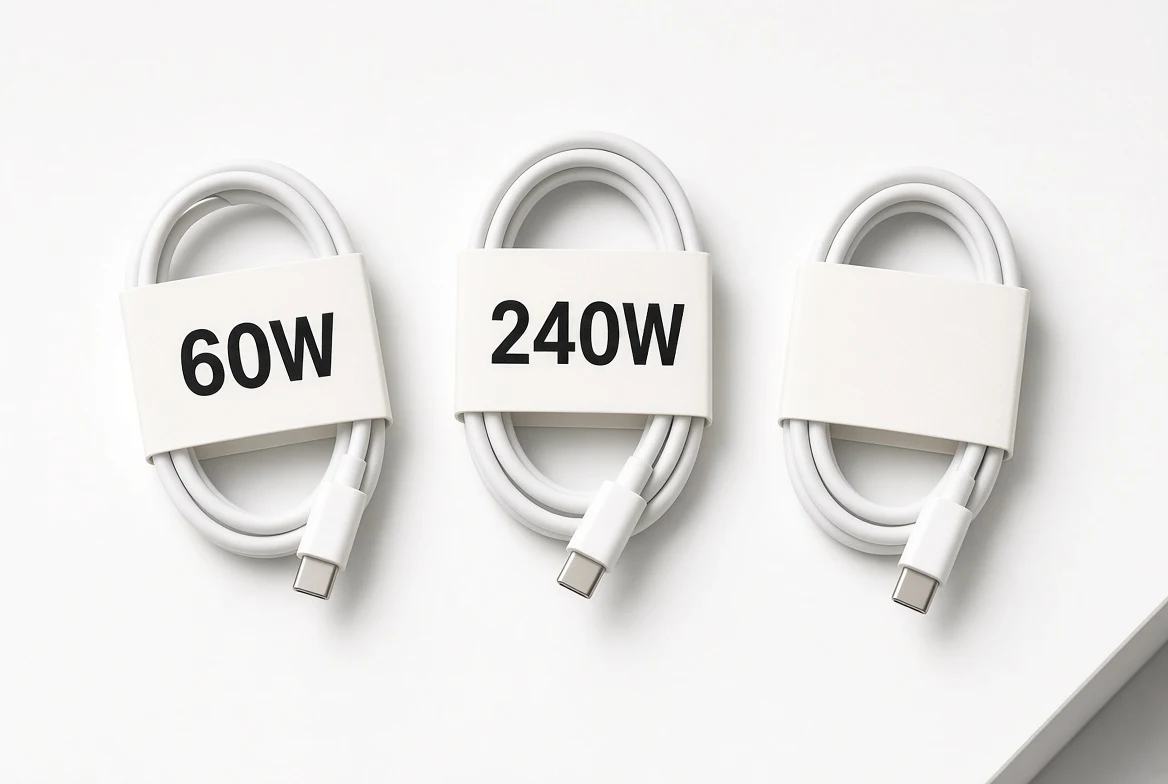
| Rated speed in Gbps for cables | 80Gbps requires cables built to the new spec; older 40Gbps passive cables carry 80Gbps only where the spec allows |
| Wattage match for wireless chargers | Qi2.2's 25W benefits only devices that negotiate it; older devices charge at their own cap |
| Power delivery figures for chargers | USB PD updates shipped alongside the speed spec; total output matters for multi-port docks |
The ecosystem rewards this diligence with longevity: a certified USB4 cable bought today is specified to work with everything backward-compatible before it, and a Qi2.2 puck down-negotiates gracefully to whatever phone is set on it. In accessories, the standard is the product — the individual gadget is just its current expression.