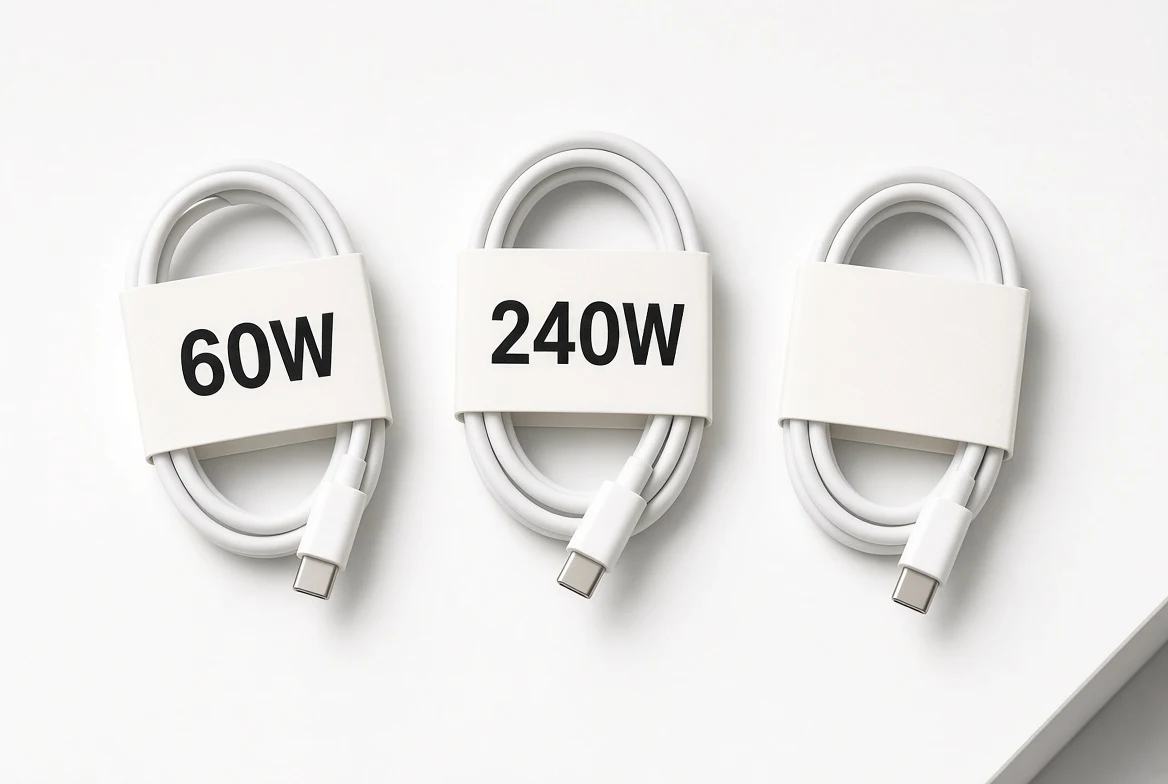
Fast charging is a negotiation, not a fire hose: a phone and a charger exchange messages over the cable or the pad and agree on a voltage and current before power flows. Under USB Power Delivery Revision 3.1, detailed on the USB-IF's official technology page, a single USB-C cable can carry up to 240 watts.
What does USB Power Delivery actually negotiate?
The USB-IF's USB Charger page describes USB PD as a specification that enables more flexible power delivery along with data over a single cable. Before Revision 3.1, USB PD topped out at 100 watts using 20 volts over cables rated at 5 amps. The 3.1 update added new fixed voltages, and the page lists exactly what each unlocks: 28 volts enables up to 140 watts, 36 volts up to 180 watts, and 48 volts up to 240 watts, extending USB power to applications where 100 watts was not adequate.
An adjustable voltage supply mode goes further, letting the device being powered request intermediate voltages between 15 volts and the charger's maximum available fixed voltage. The specification also removed the fixed direction of power — the product with the power can be either the host or the peripheral — which is why a portable monitor can charge a phone in one setup and draw power from it in another. None of this depends on a proprietary chip beyond standard PD support on both ends: the protocol itself carries the negotiation.
| USB PD fixed voltage | Maximum power | Typical use |
|---|---|---|
| 20V (pre-3.1) | 100W | Laptops, tablets |
| 28V | 140W | High-performance laptops |
| 36V | 180W | Workstations, gaming laptops |
| 48V | 240W | Desktop-class hardware over USB-C |
Why did wireless charging need magnets?
Wireless charging's old weakness was alignment. A coil in the pad induces current in a coil in the phone, and when the two coils sit off-center, efficiency collapses and heat climbs. The Wireless Power Consortium's standard page explains that Qi, initially launched in 2010, now counts over 13,000 certified products, and that Qi v2.0 — launched in 2023 and known as Qi2 — brought faster 15-watt charging together with magnetic attachment technology that keeps the coils aligned.
The magnets solved the physics problem without changing it. With the phone snapped into a fixed position, coil overlap stays constant, so the transfer holds near its best efficiency instead of degrading every time the device shifts. Certification still runs through independent authorized testing laboratories for safety and interoperability, and only certified products may display the Qi or Qi2 logo, per the WPC page. That logo is not decoration: it is the buyer's only guarantee that a pad and a device have actually been tested to work together at the advertised power.
What changed with Qi2 25W?
Power, mainly. The WPC's blog from its CES 2026 presence reports that Qi2 25W, announced in July 2025 and branded from the Qi v2.2.1 specification, lets compatible devices charge from 0 to 50 percent battery in 30 minutes. The same post notes the consortium certified over 1,200 new Qi2 and Qi2 25W devices in 2025, with charging hardware from makers including Anker, Aukey, Belkin, Nimble, Nomad, Satechi, Scosche, and UGREEN shown at the trade show.
Higher wattage over a wireless link raises the stakes on alignment and thermal management, which is part of why the magnetic profile matters more at 25 watts than it did at 5. Misaligned coils waste energy as heat exactly when the power budget is largest, and heat is the enemy of both charging speed and battery longevity. The WPC frames the gains as faster, more energy-efficient, and more convenient — the three axes the standard has traded off since 2010, now moving together instead of against one another.
Wired, wireless, or both: which should a buyer trust?
The standards have different jobs, and the honest answer is to match the mechanism to the moment. USB PD over USB-C is the high-power path: it reaches 240 watts, negotiates voltage step by step, and works for phones, laptops, and monitors alike. Qi2 is the convenience path: it tops out lower but removes the cable from the equation and, with magnets, removes the alignment guesswork that made early wireless pads slow and warm. Neither replaces the other, which is why every flagship phone still ships with a port alongside its coil.
For buyers, the practical checklist is short. On wired charging, look for the wattage a device actually accepts, not just the charger's maximum, since the negotiation settles on the lower of the two. On wireless, look for the Qi2 or Qi2 25W logo rather than generic fast-wireless claims, because the logo is tied to independent certification. And for anything above 100 watts, the USB-IF page notes the USB Type-C specification was updated to Release 2.1 to define 240-watt cable requirements — an old 5-amp, 20-volt cable will not carry a 240-watt session.
Where is inductive power heading beyond the phone?
The direction both bodies describe is the same: more power, delivered more flexibly, over fewer competing standards. The WPC's CES 2026 report also highlights Ki, its cordless kitchen standard, pushing inductive power into appliances — a sign that wireless power is scaling beyond the phone pad, toward kettles and blenders that dock onto a countertop transmitter.
What actually limits charging speed in practice?
Four things, in rough order of how often they bite: the device's own acceptance limit, cable rating, heat, and battery state of charge. The negotiation always settles on the lowest common denominator — a 240-watt charger feeding a phone that accepts 45 watts delivers 45 watts, no more, because the phone's firmware refuses the higher voltages. The charger's headline number is a ceiling, not a promise.
Heat is the quieter limit. Charging efficiency is never perfect, and the energy lost along the way becomes heat in the battery, the connector, and the pad or brick. Device makers throttle current as temperatures rise, which is why a phone that charges at full speed when cold slows noticeably under a pillow or in a car dash mount. And because lithium-ion cells accept charge fastest when nearly empty, real-world charging curves taper: the first half of a charge is fast, and the last twenty percent crawls by design. The WPC's 0-to-50-percent figure for Qi2 25W is honest framing for exactly this reason — it quotes the fast half of the curve, where the physics cooperates.
What comes next for the standards themselves?
On the wired side, USB PD's adjustable voltage mode points toward chargers that adapt to each device rather than the other way around, with the powered product requesting exactly the voltage it needs within the available envelope. On the wireless side, the WPC's move into kitchen appliances with Ki suggests the consortium sees inductive power as a general-purpose utility rather than a phone accessory feature. What has not changed is the mechanism underneath: negotiated voltage and current over copper, and aligned coils over air. Understanding those two ideas makes almost every charging headline — a new wattage record, a new magnetic puck, a new certification logo — legible at a glance.