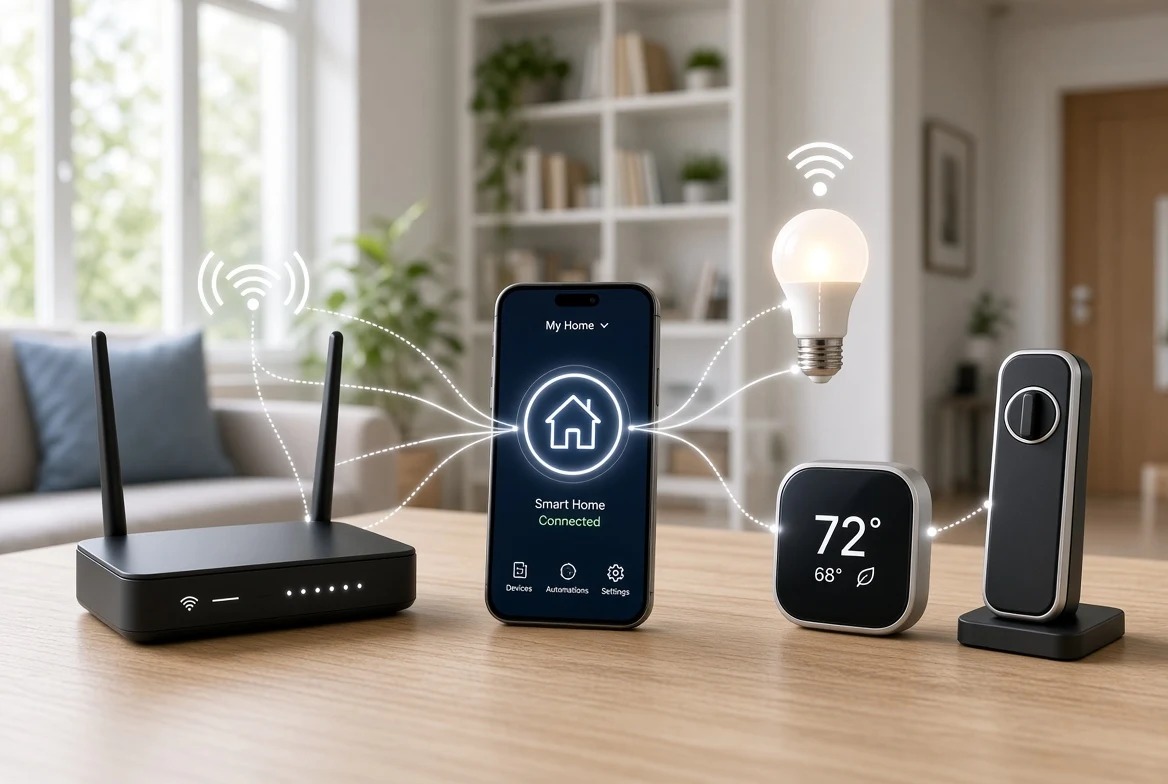

Matter is an open smart home standard, developed by the Connectivity Standards Alliance, that lets lights, locks, thermostats and blinds from different brands work across Alexa, Apple Home, Google Home and SmartThings. Its 1.4.2 update, published August 11, 2025 (announced), added Wi-Fi-only commissioning and cryptographic admin verification. The badge solves a real problem — but only part of it.
What is Matter, and who controls it?
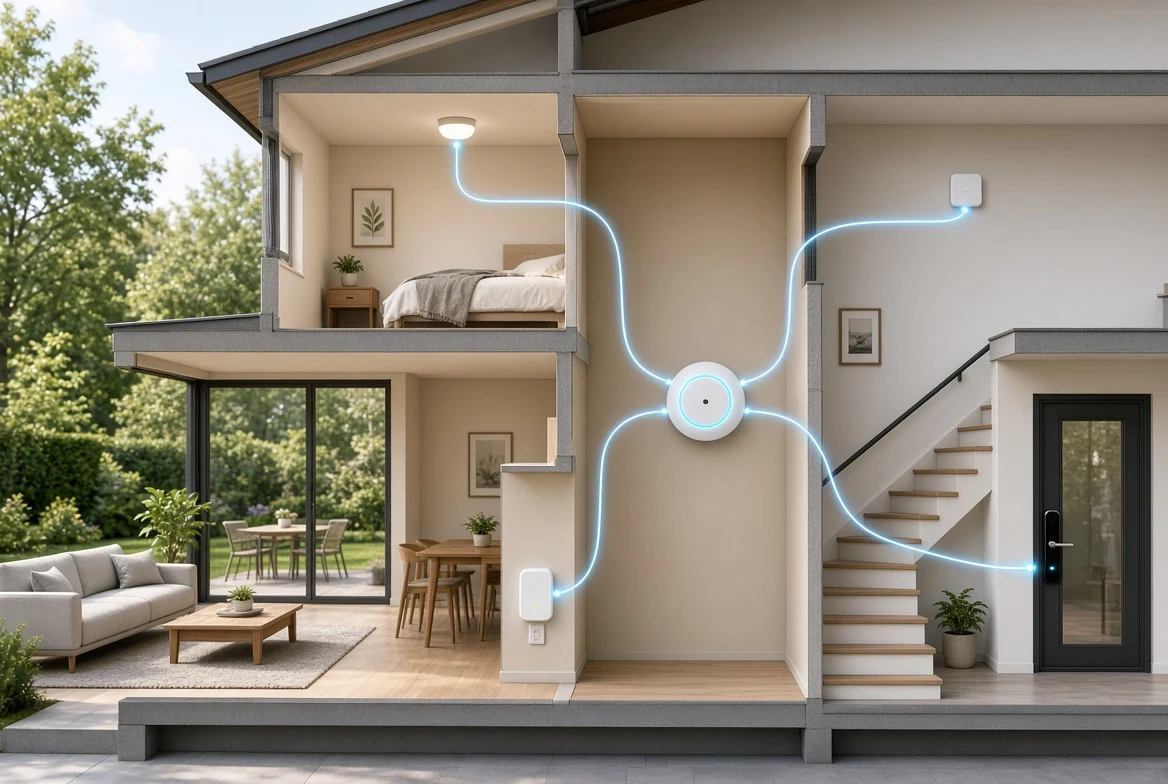
Matter is an application-layer protocol: the language devices speak, on top of existing networks. The Connectivity Standards Alliance (CSA) develops it with an open-source approach built on contributions from major companies — Amazon, Apple, Google and Samsung among them — described by the CSA as best-in-class contributions from market-tested smart home technologies. The first specification release runs on Wi-Fi and Thread network layers, and uses Bluetooth Low Energy for commissioning, the initial setup handshake.
The structure matters for buyers. Because Matter sits on top of IP networking, a Matter device joins the local network directly rather than phoning home through a vendor bridge. And because the standard is controlled by a consortium rather than any one ecosystem, no single assistant maker can revoke compatibility wholesale. That is the core promise printed on every Matter box: one device, every major platform.
Thread deserves a word, since the two names travel together. Thread is a separate low-power mesh networking standard maintained by the Thread Group, designed to connect and control products in the home over an IPv6-based protocol. Matter defines what devices say; Thread is one way they say it — the best option for battery-powered sensors and locks.
What did smart homes look like before Matter?
The problem Matter was created to solve is easy to forget because it defined a decade of the category: device silos. Before the standard, a light bulb spoke Zigbee to one hub, a lock spoke Z-Wave to another, and anything Wi-Fi based spoke only to its maker's cloud. Buyers navigated compatibility matrices, and ecosystems courted manufacturers into exclusivity. A house was not a system; it was a federation of incompatible subscriptions.
Matter's answer was to standardize the application layer over IP, so that any compliant device could be addressed natively by any compliant controller. That is why the CSA's framing emphasizes unification rather than novelty — the marketing promise is interoperability, a seal of approval that devices will work together across ecosystems, in the Alliance's own description of the standard's value. Version history since then has been a steady widening of what falls under that seal: more device types, more energy hardware, stronger security checks, better setup flows.
The competitive truce embedded in the standard is unusual and load-bearing. Amazon, Apple, Google and Samsung all contribute to an open-source code base and all ship controllers that accept third-party Matter devices — a structure that survives only because no single member can steer the specification exclusively. Buyers benefit from that balance of power every time a device pairs with a rival's assistant without negotiation.
How does a Matter device get set up?
Commissioning is the standard's most polished user experience. A new device broadcasts its presence, the buyer scans a QR code or enters a setup code in the chosen app, and the device joins the home's Matter fabric — the shared trust domain that links controllers and endpoints. Bluetooth Low Energy historically carried this handshake; Wi-Fi-only commissioning using Wi-Fi Unsynchronized Service Discovery arrived with Matter 1.4.2, per the CSA's announcement (announced).
The second mechanism is multi-admin. From the start, Matter allowed a device to be controlled by several ecosystems at once — an iPhone and an Android tablet in the same house, for example. The 1.4 release upgraded this to Enhanced Multi-Admin, which as covered at the time lets devices connect to multiple ecosystems automatically with a single user approval, removing the per-platform pairing ritual.
Setup is also where the new security checks bite. Under Matter 1.4.2, controllers can cryptographically verify that the admins installed on a device are genuinely from the vendors they claim, and ecosystems can use certificate revocation lists to warn users during commissioning and block unsecured devices from entering the network — both documented changes in the CSA's release (announced).
What did versions 1.4 and 1.4.2 actually change?
The standard has moved fast enough that a device's certified version now tells you a lot. The two most consequential releases for buyers:
| Version | Released | Headline additions |
|---|---|---|
| Matter 1.4 | December 2024 (announced) | Enhanced Multi-Admin with single approval; energy management device types — solar panels, batteries, heat pumps, water heaters; standardized router and access point integration |
| Matter 1.4.2 | August 2025 (announced) | Wi-Fi-only commissioning via USD; cryptographic admin verification; certifiable scenes across devices; certificate revocation lists |
The energy additions in 1.4 are more than a feature list. As the launch coverage noted, support for inverters, battery walls and heat pumps makes energy savings automation possible — devices that historically lived in proprietary apps joined the same fabric as everything else. Router support matters quietly too: future Wi-Fi access points can double as Thread border routers, which expands the mesh without extra boxes.
Where does Matter stop?
The badge does not promise feature parity. A Matter-certified lock will lock and unlock everywhere, but its fingerprint sensor, auto-lock timers or proprietary camera feed may still need the maker's own app — those functions sit outside the standard. Ecosystem-specific features, from voice routines to advanced automations, are likewise not guaranteed to cross platforms, and some categories have arrived late or partially: cameras joined the specification only after the early releases, and bridged devices — older Zigbee or Z-Wave gear exposed through a hub — support a subset of Matter functions.
Version fragmentation is the quieter trap. A device certified to Matter 1.2 still works, but it will not expose the multi-admin improvements of 1.4 or the security verification of 1.4.2. The version is printed in certification records, and it is the single most useful line of small print on a product page.
The energy-management additions illustrate the gap between standard and experience. Matter 1.4 defines the device types and clusters for solar arrays, storage batteries, heat pumps and water heaters — including, as the release coverage detailed, a boost command for rapid water heating and heat-pump support that can forecast consumption and shift usage toward off-peak windows. But automations built on those clusters arrive only when ecosystems implement them, which historically trails the specification by quarters. The standard sets the ceiling; each platform decides how much of it ships.
Scenes, upgraded to certifiable status in 1.4.2, are the latest example. A standardized way for controllers to define and activate scenes across multiple Matter devices means a movie-night or away routine can finally travel between platforms — but only among devices and controllers that both certify to the newer spec. Mixed-version homes will feel this limitation for years.
How should a buyer actually use the Matter logo?
Treat the badge as a floor, not a ceiling. A practical check before any purchase:
- Confirm the certified Matter version in the product listing — newer means better multi-admin and security behavior.
- Check which radios it carries: Thread plus Wi-Fi devices are the most future-proof; Wi-Fi-only devices need no border router but draw more power.
- Verify your ecosystem list includes every assistant you actually use, since multi-admin is the feature doing the heavy lifting.
- Decide which advanced features you need in the maker's app, and accept that those will not cross platforms.
The standard's own announcements, like the Matter 1.4.2 release notes, are the most reliable place to check what a given version guarantees — before the box's promises meet your particular mix of hubs and phones.