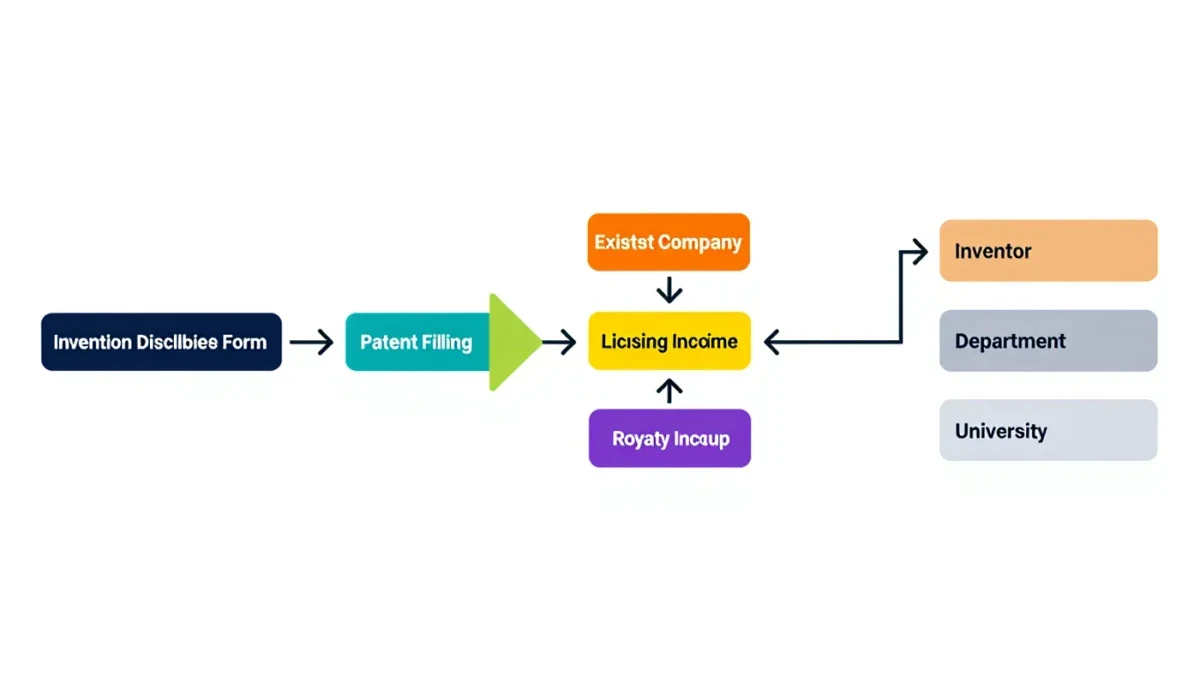

Technology transfer is the process that turns a university lab result into a real company. A technology transfer office, or TTO, manages that process. It identifies research with commercial potential, protects it with patents, and licenses it to startups or established firms.
The office sits between two worlds that work on different clocks. Researchers publish. Companies ship. The TTO's job is to bridge that gap without stalling either side. Most research universities in the United States run one, and the model exists in some form at institutions worldwide.
At its core, the work is about applied knowledge. Technology, as Wikipedia defines it, is the application of conceptual knowledge to achieve practical goals in a reproducible way. A TTO applies that definition to a specific asset: a discovery made on public or institutional funding that someone outside the lab could build a business on.
What does a technology transfer office actually do?
A TTO has three main functions: disclosure management, intellectual property protection, and commercialization. Each one feeds the next.
It starts with disclosure. When a researcher believes she has something commercially interesting — a new material, an algorithm, a medical device — she files an invention disclosure with the office. This is a confidential internal document. It describes the invention and names the inventors. The TTO then evaluates it: Is it new? Does it work? Would anyone pay for it?
If the answer is yes, the office decides whether to seek patent protection. Patents are expensive to file and maintain, so most offices decline more disclosures than they accept. A rejected disclosure usually returns to the researcher, who is then free to publish or pursue it without institutional involvement.
The third function is the deal itself. The office negotiates a license — an agreement that gives a company the right to use the patented invention, usually in exchange for fees and royalties. When the licensee is a new company built around the invention, that company is called a spinout.
How does a university spinout actually get formed?
The path from disclosure to incorporation follows a recognizable sequence, though details vary by institution.
- Disclosure. The inventor files a written description of the invention with the TTO.
- Evaluation. The office assesses the science, the patent landscape, and the market. This can take months.
- Protection. If the invention clears evaluation, the office files a provisional patent application, which holds the filing date while the team decides whether to invest in a full patent.
- Team formation. A spinout needs more than an invention. It needs a founding team, often the academic inventor plus an external CEO or business lead.
- License negotiation. The TTO and the founders agree on terms: upfront fees, milestone payments, royalties on future sales, and usually equity.
- Incorporation and funding. The company forms, signs the license, and raises outside capital, typically from angel investors or venture funds.
The license is the hinge of the whole process. It converts something the university owns into something a company can build on. Without it, investors will not fund the company, because the company would have no clear right to its core asset.
Why do universities take equity in spinouts?
Equity is the TTO's second-favorite currency after royalties. Instead of charging a young company a large upfront fee it cannot afford, the university takes an ownership stake — often in the low single digits of the company's shares.
The logic is straightforward. Early-stage startups are cash-poor. A heavy license fee at incorporation can kill the company before it starts. Equity aligns incentives differently: the university wins only if the company survives and grows. If the startup later raises venture rounds or is acquired, that stake can become worth far more than any fee. This connects to our earlier piece, How to Read Startup Milestones in a $300 Billion AI Market.
Practices vary widely. Some offices take equity and reduce royalties. Some take equity and keep standard royalty terms. Some waive fees for local companies to encourage regional job creation. There is no single standard; each university sets its own policy, and founders should read it before negotiating.
What does this mean for founders and researchers?
For researchers, the practical takeaway is timing. Talking to the TTO before publishing matters, because a public disclosure — a paper, a conference talk, even a poster — can destroy the ability to patent the invention in most jurisdictions. The office exists partly to prevent that accident.
For founders, the takeaway is that license terms are negotiable, but not infinitely so. Universities have standard term sheets, and the equity-and-royalty package reflects institutional policy, not personal whim. The negotiation usually turns on milestones: what the company must achieve before payments come due. A well-structured license ties obligations to the company's actual funding stages.
For investors, the TTO is a signal to examine, not a guarantee. A clean license from a reputable office reduces one category of risk — unclear ownership of the core technology. It says nothing about whether the market wants the product.
Our analysis of the model's trade-offs: the system works well when the invention is patentable and the market is clear. It works poorly for software and AI research, where fast-moving fields often outpace the patent process, and where open publication may spread a technique faster than any license could. Many AI-oriented universities now treat transfer more flexibly, relying on sponsored research partnerships with companies rather than exclusive patents. The pattern is visible across the current market, where corporate AI partnerships — like the structure behind AMD's $5 billion Anthropic deal — increasingly substitute for traditional licensing. Readers following this should also see AMD's $5 Billion Anthropic Deal Shows How AI Partnerships Really Work.
Why the model matters for the wider innovation economy
University research is upstream of most product markets. Materials science, biotechnology, and computing all draw heavily on academic work before any company touches it. The transfer office is the checkpoint where that upstream work either enters the market or does not.
The broader definition of the field supports this framing. As SciTechDaily describes it, technology spans fields from computing and biotechnology to renewable energy and materials science, and evolves through research and innovation. TTOs are where one specific slice of that evolution — publicly funded research — gets a route to commercial life.
The system has known criticisms. Offices are often criticized as slow, and patent-heavy strategies can sit on inventions that never find a licensee. Defenders answer that the alternative — universities giving away research with no structure — would produce fewer deals, not more. Both views contain truth, and the balance differs by institution and by field.
What remains unknown is how the model adapts to AI-era research, where the line between a publishable paper and a product blurs week by week. The machinery described here was built for inventions that mature slowly. Whether it bends fast enough for fields that do not is the open question the next decade of spinouts will answer.