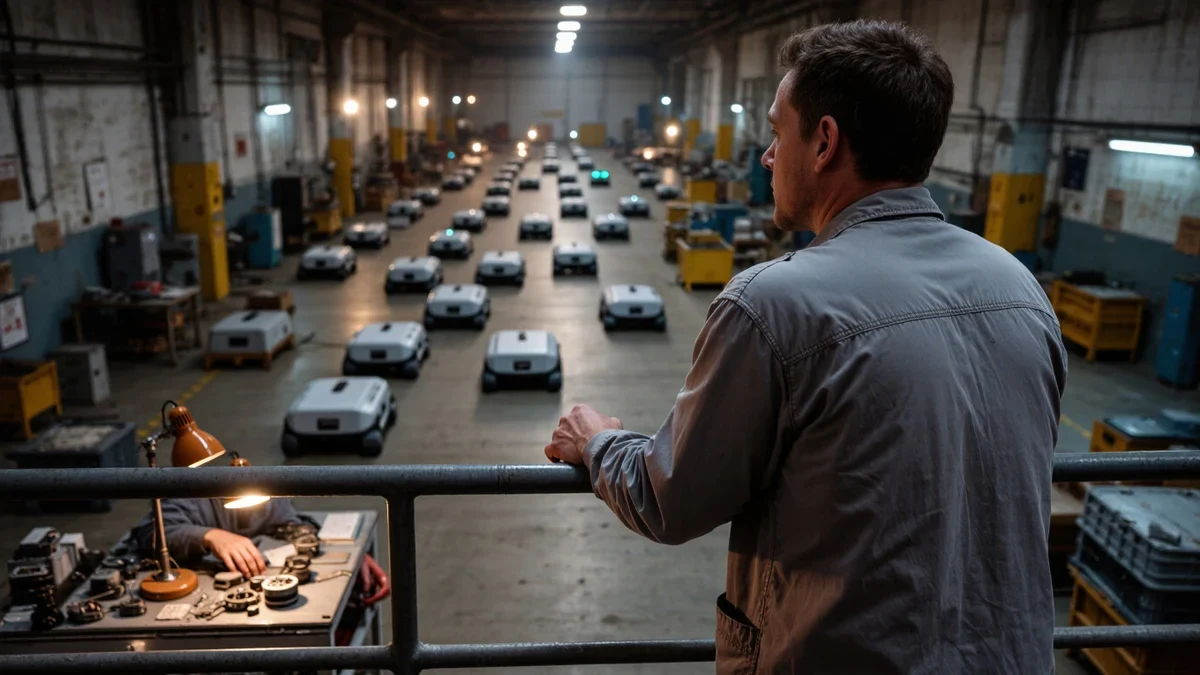
Amazon's global network passed one million deployed robots across more than 300 facilities, according to the company's own announcement in mid-2025 (announced). The same notice introduced DeepFleet, a generative AI system that Amazon says improves fleet travel time by 10 percent. Together they offer the clearest public picture of how modern logistics automation actually runs.
How does a robot-run fulfillment center actually work?
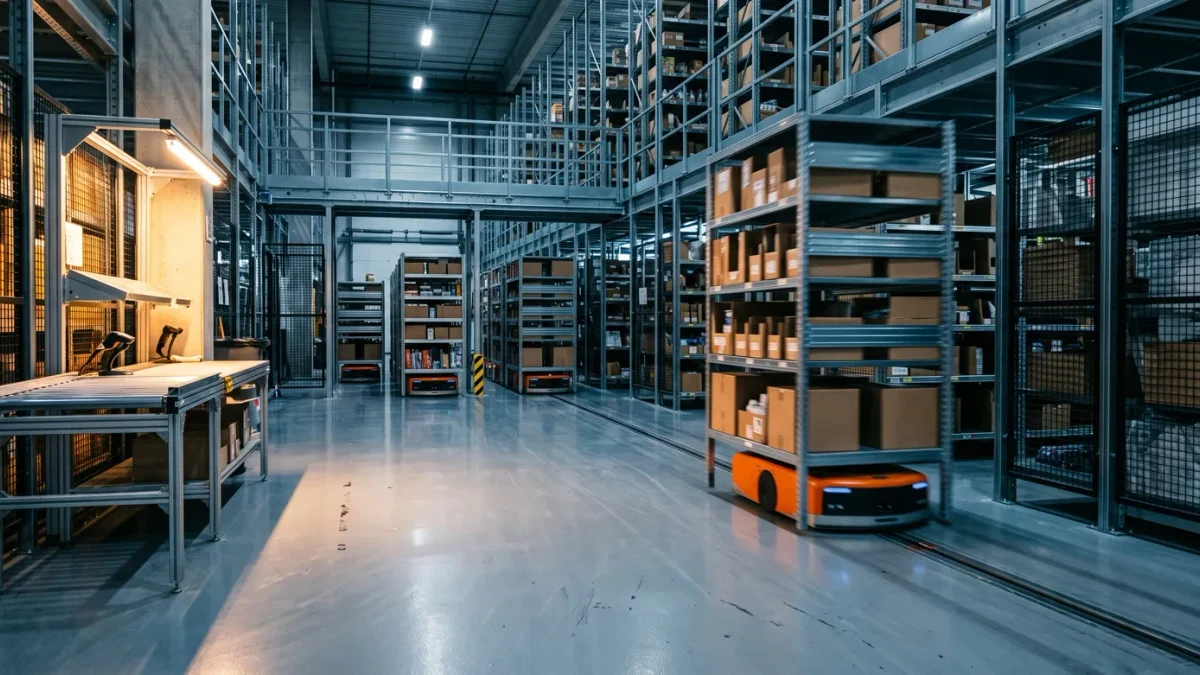
A modern Amazon fulfillment site is not a warehouse with a few robots; it is a flow system organized around them. The company's operations overview describes single sites where eight different robotics systems work in harmony to support package fulfillment and delivery. Mobile drive units carry shelves of inventory to stationary workers, robotic arms handle items at fixed points, and autonomous carts move finished packages toward loading docks.
The storage layer is where the biggest claimed gains sit. According to Amazon's overview, the Sequoia system enables the company to identify and store inventory up to 75 percent faster at its fulfillment centers (company-claimed). Sequoia works by having mobile robots transport containerized inventory directly to tall gantry frames, which speed up both the putting away and the retrieving of goods. That inversion — goods moving to people, rather than people walking to goods — is the core mechanic of every large robotic warehouse, at Amazon and beyond.
Containerization is the second quiet principle. By holding inventory in standardized totes rather than loose shelving, the site turns every storage and retrieval task into the same mechanical problem — lift a known box, move it a known distance — which is exactly the kind of problem robots solve reliably. The overview's description of eight systems working in harmony is really a description of interfaces: each machine hands a standardized object to the next, and the human touch points sit at the joints where flexibility is still worth paying for.
The picking layer is progressively automated too. Vulcan, described by Amazon as its first robot with a sense of touch, picks and stows items from high and low bins. Sparrow, a robotic arm, moves individual items into totes. Cardinal, an AI-driven arm, lifts, reads labels and sorts packages weighing up to 50 pounds, which Amazon says reduces injury risk for employees who would otherwise handle those packages manually (company-claimed).
What is DeepFleet and how does it coordinate a million robots?
One million robots create a traffic problem. Amazon's answer, announced alongside the milestone, is DeepFleet — described in the company's release as an intelligent traffic management system for a city filled with cars moving through congested streets. Built as a generative AI foundation model on Amazon's own inventory-movement datasets using AWS tooling, it predicts congestion across the network and routes robots around it, improving fleet travel time by 10 percent (announced).
The technical detail is public. A paper from Amazon Robotics researchers, "DeepFleet: Multi-Agent Foundation Models for Mobile Robots," submitted to arXiv in August 2025, describes a suite of foundation models designed to support coordination and planning for large-scale mobile robot fleets, trained on movement data from hundreds of thousands of robots in Amazon warehouses worldwide. The paper compares four architectures: a robot-centric autoregressive decision transformer, a robot-floor model using cross-attention, an image-floor model using convolutional networks, and a graph-floor model combining temporal attention with graph neural networks.
The result matters for the whole logistics sector. The authors report that the robot-centric and graph-floor models performed best, because both handle asynchronous state updates and capture localized robot interactions, and that both scale well with larger warehouse datasets. In plain terms: the coordinator does not plan one robot's path; it learns the geometry of congestion itself.
The foundation-model framing is the interesting part. Earlier warehouse traffic systems relied on hand-tuned rules or classical multi-agent path planners, which degrade as fleet counts climb into the tens of thousands. A model trained on observed movement — including the messy, suboptimal reality of real floors — can generalize to new layouts and demand patterns without a full replanning infrastructure. That is why Amazon describes DeepFleet as coordinating movement across the network rather than routing any individual robot, and why the reported 10 percent travel-time gain (company-claimed) is a network-level statistic, not a per-machine one.
There is also a data advantage that competitors cannot shortcut. The training corpus — hundreds of thousands of robots, per the paper — exists only because Amazon has operated at this scale for over a decade, since its 2012 acquisition of Kiva Systems gave it a head start on robot-native warehouse design. Any logistics operator building a comparable coordination layer has to either generate comparable telemetrics or rent the capability.
Which robot does which job?
Amazon's own operations overview, which walks through the robots at a single site, assigns each machine a narrow role. The division of labor is the design lesson: no general-purpose robot appears anywhere in the fleet.
| System | Job | Documented capability |
|---|---|---|
| Sequoia | Inventory storage and retrieval | Identifies and stores inventory up to 75% faster (company-claimed) |
| Hercules | Drive unit | Moves pods of items to pickers |
| Titan | Heavy-lift drive unit | Carries bulkier items |
| Vulcan | Pick and stow | First Amazon robot with a sense of touch |
| Sparrow | Item handling arm | Moves individual items into totes |
| Robin | Package sorting arm | Sorts packages toward outbound docks |
| Cardinal | Heavy package arm | Handles packages up to 50 pounds |
| Proteus | Autonomous transport | Navigates freely using sensors to avoid obstacles |
How does an order actually move through this system?
Putting the pieces together, the path of a single order through a robotic site, as described in Amazon's operations overview, runs roughly as follows:
- Incoming inventory is containerized and stored by the Sequoia system, with mobile robots and gantries handling put-away.
- When an order arrives, drive units such as Hercules bring the relevant pods to a picking station.
- Vulcan or Sparrow — or a human picker — selects the item, with Vulcan handling both high and low bins.
- Packaging automation produces made-to-fit paper bags for the order, cutting filler material.
- Robin and Cardinal sort the packaged order toward outbound docks, and Proteus moves carts of packages the last stretch to loading.
What are the limits of one million robots?
The record deserves its skepticism. Every efficiency figure in this story — the 75 percent storage speedup, the 10 percent travel-time gain — is company-claimed, published by Amazon rather than independently audited. Amazon frames the goal of its robotics technology as pairing employees with the right technology to make their workday safer and easier, and says it has upskilled over 700,000 employees since 2019 (company-claimed). The deployment is also uneven: a million robots across more than 300 facilities worldwide averages out to sites of very different automation levels.
Exception handling remains the stubborn human job. Irregularly shaped items, damaged goods and edge cases in picking are precisely where touch-sensitive systems like Vulcan are still being introduced, which says as much about what was hard before as about what is solved now.
Why does this matter beyond Amazon?
For everyone outside Amazon, the takeaway is architectural. Logistics networks are becoming fleets coordinated by learned traffic models — and the coordination layer, not the individual robot, is where the measurable gains are being reported. The DeepFleet paper is effectively a public specification of that layer: the state representations, the four architectures, the evaluation against real warehouse data. Any competitor, courier or third-party warehouse operator can read exactly how the problem is being framed.
The pattern also redraws what counts as logistics technology. A decade ago the category meant conveyors, sortation machines and warehouse management software. The current build-out adds fleet-learning systems — models whose value compounds with every operating hour — alongside the machines themselves. That shifts procurement logic: hardware refreshes matter less than the telemetry and coordination stack a provider can sustain.
For the broader automation debate, the million-robot milestone is a data point rather than a verdict. Amazon itself pairs the announcement with retraining claims — over 700,000 employees upskilled since 2019, per the company's release — while the robots keep taking over transport, storage and heavy lifting. Which of those trends defines the next decade of logistics work is a question the announcement cannot answer; what it does document is the direction of the machines.