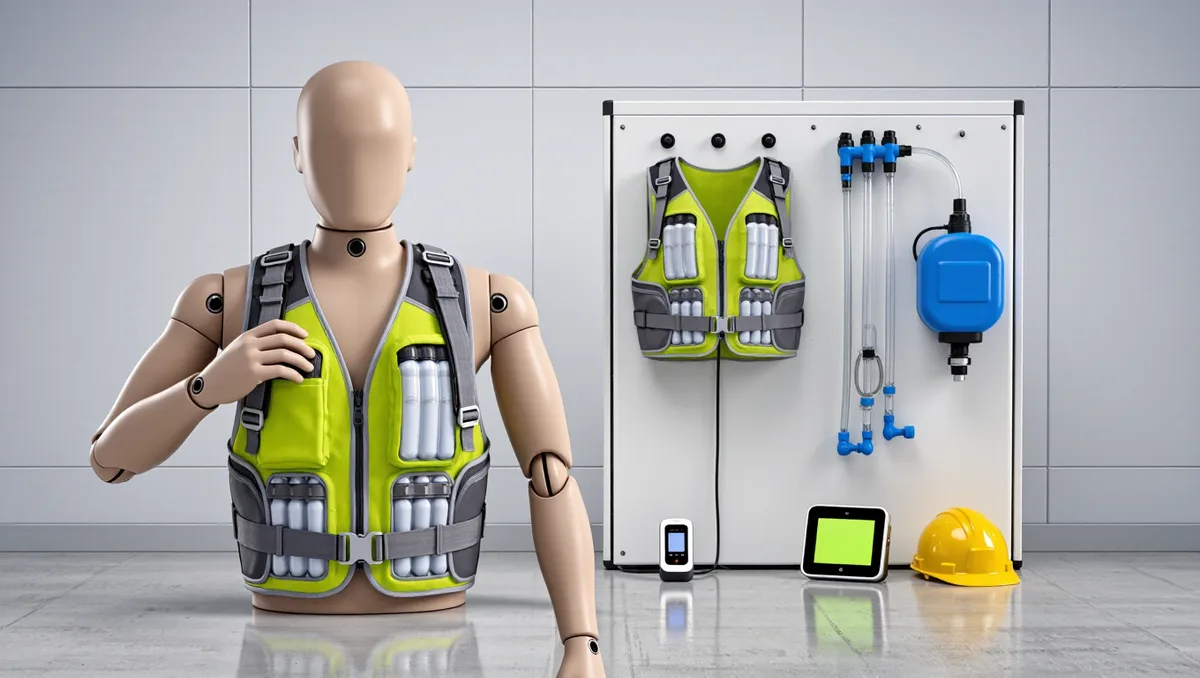
Cooling vest technology is wearable clothing designed to help the body manage heat by reducing heat around the wearer, rather than cooling an entire room. According to Intelligent Living, these garments combine new materials, lightweight designs, and different cooling mechanisms to change how people handle hot working environments. The central insight for buyers and specifiers is that there is no single best approach — each of the main technologies wins in a different setting.
The reason the category exists is practical, not cosmetic. For people in construction, manufacturing, logistics, healthcare, or emergency services, managing heat is described by Intelligent Living as essential for maintaining concentration, physical performance, and personal safety. Traditional methods such as fans and air conditioning remain useful, but they are not always practical when people need to move freely or work where cooling infrastructure is unavailable. That gap is exactly what wearable cooling products target: they cool the person, not the space.
That person-focused approach is also what makes the category interesting from an innovation standpoint. As with other areas of wearable engineering — the same logic behind how continuous glucose monitors turn a tiny wire into all-day health data — the value comes from moving a function that used to require fixed infrastructure onto the body itself. A vest that needs no electrical connection or ducting can go where air conditioning cannot. We covered a connected angle in How Continuous Glucose Monitors Turn a Tiny Wire Into All-Day Health Data.
How does the body lose heat, and where does it fail?
The body constantly produces heat, and muscles generate additional warmth during physical activity. The natural response is to increase blood flow to the skin and produce sweat; when sweat evaporates, it removes heat from the skin. Intelligent Living explains that this is one of the body's built-in cooling mechanisms.
The problem is that this mechanism has known failure modes. High humidity slows evaporation, and protective clothing combined with demanding physical work can make it harder to maintain a comfortable temperature. Wearable cooling technology builds on the same principles by adding extra ways to transfer heat away from the body or create a cooler microclimate around the wearer. Results depend on several factors: the cooling technology used, ambient temperature, humidity, airflow, clothing layers, and how intense the activity is. No single method works equally well in every situation, which is what makes choosing the right product important.
Which cooling vest technology fits which environment?
The main technologies split along environmental lines, and the differences are the whole story.
Evaporative cooling vests
Evaporative vests use water evaporation to create the cooling effect. They contain specialised materials that absorb and retain water; as the water gradually evaporates, heat is drawn away from the garment and its surroundings. Depending on the design, activation is often as simple as soaking the vest in water, draining the excess, and wearing it per the manufacturer's instructions.
The structural advantage is independence: no batteries, no electrical connections, no frozen inserts. That makes the approach attractive for people spending extended periods outdoors, including cyclists, warehouse employees, construction workers, and maintenance professionals. The catch is environmental dependence — evaporative cooling works best with sufficient airflow and humidity that is not excessively high. In very humid conditions, evaporation slows and the cooling effect drops. This is the mirror image of the body's own sweat-based system: the vest inherits the same weakness the body has.
Phase change cooling vests
Phase change vests use materials that absorb heat as they change from one physical state to another, often maintaining a relatively stable temperature range during the transition. Many products use removable cooling packs that must be chilled or frozen before use, depending on the material and the manufacturer's specifications.
This approach suits environments where consistent cooling is needed and water evaporation is less suitable — industrial facilities, laboratories, specialist workplaces, and activities where humidity is a challenge. The trade-off is duration: these garments have a finite cooling window. Once the material has absorbed its available heat, it must be reconditioned before reuse. In effect, the buyer trades humidity independence for logistics — a supply of chilled packs and a rotation plan.
Active cooling wearables
The third approach involves active cooling systems that use electricity. The retrieved source's account of this category is incomplete, cutting off at the point where it begins to describe how these powered systems operate, so any detailed claims about their performance, weight, or runtime would go beyond the evidence. What the source does establish is that powered cooling is a distinct third branch of the category, separate from passive water-based and phase change approaches.
What the design constraints mean for the market
The through-line across all three approaches is a shared engineering brief: provide additional cooling without significantly restricting movement. A well-designed vest should fit comfortably under or over other clothing, remain practical during everyday tasks, and allow natural movement. Intelligent Living notes that manufacturers are working on improving cooling performance, reducing garment weight, and making products easier to use throughout the working day.
The analysis that follows from the evidence is straightforward. Because performance is environment-dependent — humidity kills evaporative cooling, finite duration limits phase change, and powered systems carry their own constraints — the category is unlikely to consolidate around one winner technology. Instead, expect segmentation by workplace: dry, airy outdoor sites for evaporative designs; humidity-controlled or specialist indoor settings for phase change; and a role for powered systems where the source's incomplete account leaves open questions. For buyers, the practical takeaway is to match the mechanism to the environment first and the garment second. For a broader view of how hardware innovations move from concept to market, see the magazine's innovation coverage, and for related material systems work, Graphene, Two Decades On: How a One-Atom Material Reaches Industry traces a comparable path from physics to product. Readers following this should also see Graphene, Two Decades On: How a One-Atom Material Reaches Industry.