A quantum computer is a machine that stores information in quantum states — qubits — and exploits superposition and entanglement, properties classical bits lack. Google's 105-qubit Willow chip, announced December 9, 2024, demonstrated both the approach's promise and its central obstacle: errors, which multiply with every qubit added unless error correction works. That obstacle is now the industry's main event.
What is a quantum computer, in practical terms?
A quantum computer is a processor whose basic unit of information is a qubit rather than a bit. A bit is a switch: 0 or 1. A qubit is a quantum object — a superconducting circuit, a trapped ion, a photon — whose state can be prepared in a combination of 0 and 1 until it is measured. Quantum algorithms manipulate many such states at once and use interference, the wave-like reinforcement and cancellation of probabilities, so that wrong answers cancel out and correct answers accumulate.
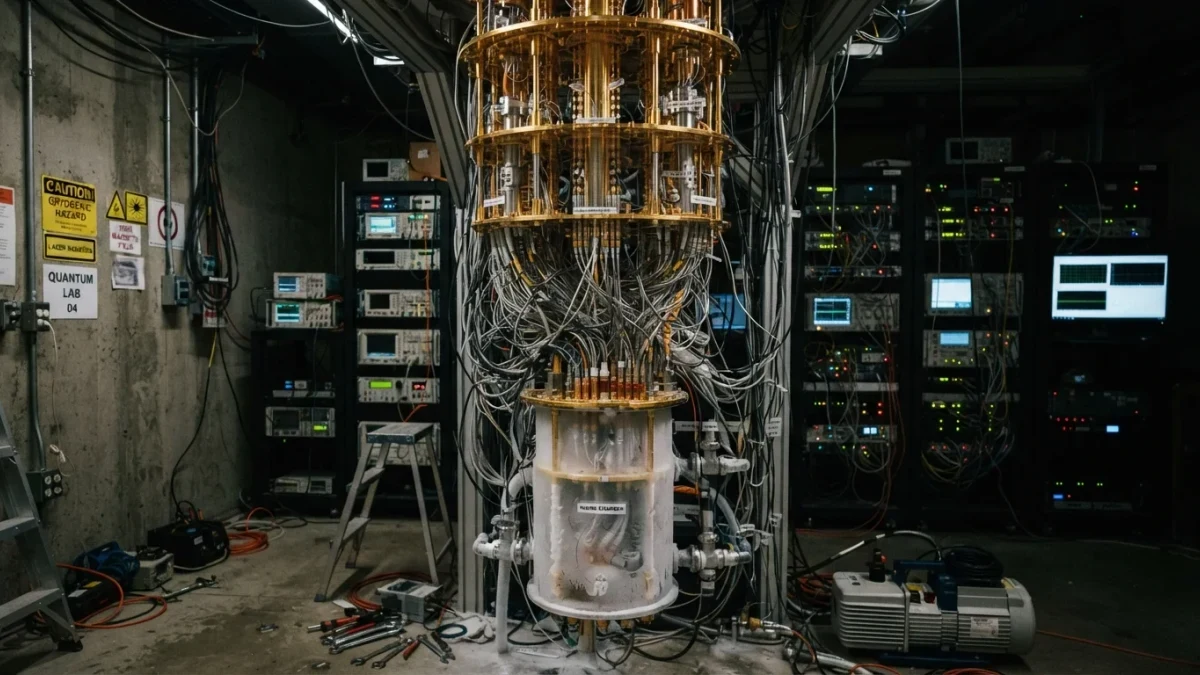
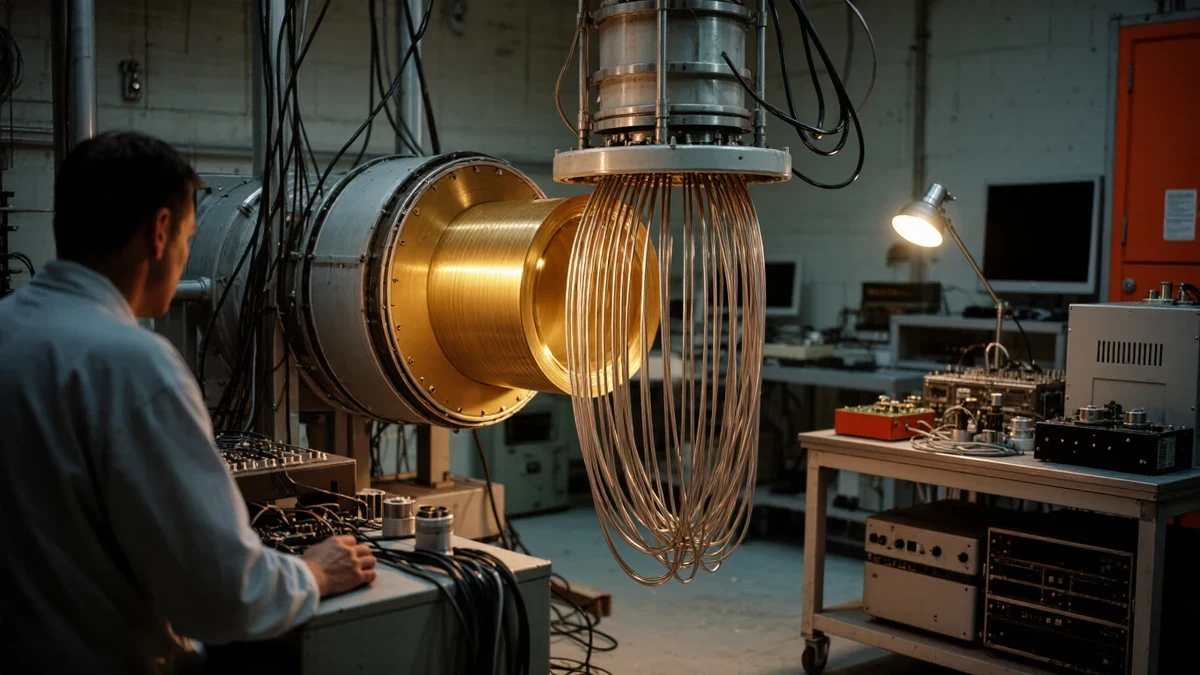
The hardware is ostentatiously hostile to computation. Most leading processors, including Google's, are superconducting chips cooled to around 15 millikelvin — colder than deep space — because thermal noise destroys quantum states. Others, such as trapped-ion machines, hold individual atoms in electromagnetic traps in vacuum chambers. Either way, the machine's visible footprint is mostly refrigeration and shielding, with the quantum processor itself a chip a few centimeters across.
The point of all this engineering is not speed in general. Quantum computers are slow at arithmetic, sorting, and every ordinary computing task. Their advantage is narrow and mathematical: certain problems — factoring large numbers, simulating molecular interactions, some optimization and cryptography-related computations — have structure that quantum algorithms can exploit and classical algorithms, as far as anyone knows, cannot.
What is a qubit, and what is superposition?
A qubit is a two-level quantum system whose state is described by two amplitudes, one for 0 and one for 1, whose squared magnitudes give the probabilities of measuring each outcome. Superposition is the name for this in-between state, and its useful property is linear algebra: n qubits in superposition represent a combination of 2-to-the-n basis states, which quantum gates transform as one object.
Superposition is often illustrated as a coin spinning in the air, neither heads nor tails until it lands. The illustration is fair but incomplete, because the useful part is not the ambiguity — it is that gates operate on all the amplitudes simultaneously. Entanglement then links qubits so that the state of the pair is not describable piece by piece, which is what lets quantum algorithms correlate answers across the whole register.
Two consequences follow. First, measuring a qubit destroys its superposition and yields one classical bit, so a quantum program is a carefully designed gamble: interfere the amplitudes so the measurement is likely to return the answer. Second, qubits cannot be copied mid-computation — the no-cloning theorem — which rules out the simplest ideas for backing up quantum state and makes error correction a logical rather than a brute-force problem.
Why do errors dominate quantum computing?
Errors dominate because qubits are fragile in exact proportion to their power. A superconducting qubit holds its state for tens to hundreds of microseconds; a trapped ion for seconds. Every gate operation adds inaccuracy, and stray radiation, control-electronics noise, and crosstalk between neighboring qubits add more. Google's own announcement put the stakes plainly: with 105 qubits, Willow's best-in-class performance showed that the more qubits in the machine, the more chances one of them ruins the computation.
The classical workaround — redundancy, copying data to backup drives — is unavailable, because quantum states cannot be cloned. The working alternative is quantum error correction: entangle one logical qubit across many physical qubits, measure carefully chosen parity checks, and use the results to diagnose and correct errors without ever reading the encoded information itself. A surface code, the leading scheme, arranges qubits in a square lattice where each round of measurement spots whether an error has appeared and where, roughly, it sits.
The catch has always been the threshold. If physical error rates are above a certain level, adding qubits adds errors faster than correction can remove them, and scaling makes things worse. Below threshold, the math reverses: each enlargement of the code suppresses errors exponentially. Thirty years of quantum computing research was, in large part, the hunt for a machine that could get below that line.
What did Google's Willow chip demonstrate?
Willow demonstrated below-threshold error correction on real hardware. In Google's technical account, Willow is the first processor where error-corrected qubits get exponentially better as they get bigger: each time the surface-code lattice grew from 3x3 to 5x5 to 7x7, the encoded error rate fell by a factor of 2.14. That direction — bigger code, fewer errors — is the reversal the field had been chasing.
Google also used Willow to run a random circuit sampling benchmark in under five minutes, a computation the company estimated would take one of today's fastest supercomputers around 10 septillion years. The benchmark is real but narrow: random circuit sampling is designed to be hard for classical machines and easy for quantum ones, and it has no commercial application. Its function is to prove the machine computes something genuinely quantum, not to preview a product.
The honest framing is that Willow proved a mechanism, not a market. A logical qubit that improves with scale is the prerequisite for every future application — chemistry simulation, materials, cryptanalysis — but a useful machine needs thousands of high-quality logical qubits, and Willow's distance-7 code encoded a single one from roughly a hundred physical qubits.
When will quantum computers be useful?
No published, verifiable date exists for a broadly useful quantum computer, and any confident one should be treated as a goal rather than a schedule. What the public record supports is a direction: error-corrected logical qubits as the metric that matters, replacing the raw physical-qubit counts that earlier roadmaps advertised.
For chemistry and materials, plausibly early applications, the requirement is fault-tolerant machines large enough to simulate molecular orbitals past what classical approximation can reach. For cryptography, the stakes are already concrete: a machine able to run Shor's algorithm at scale would break RSA and elliptic-curve encryption, which is why standards bodies have spent years migrating to post-quantum schemes in advance.
Between now and then, the measurable milestones to watch are logical-qubit count, logical error rate per cycle of computation, and the ratio of physical to logical qubits. When that ratio falls and the logical counts rise together, error correction stops being the whole story — and quantum computing becomes an engineering problem of the ordinary, unglamorous kind.
What are the competing hardware approaches?
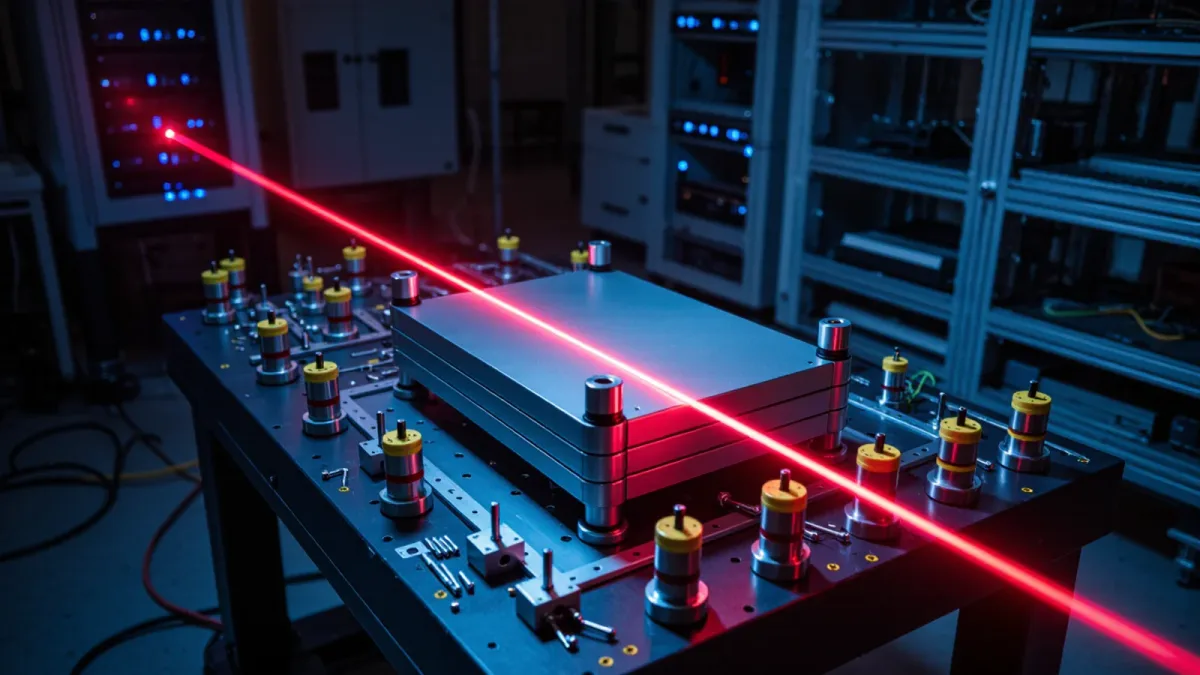
Superconducting circuits, Google's choice, trade coherence time for speed: gates run in nanoseconds, but states decay in microseconds, all inside a dilution refrigerator. Trapped ions trade speed back for fidelity: single-qubit operations are slower by orders of magnitude, but coherence stretches to seconds and gate qualities are higher, at the cost of complex laser control per ion. Neutral-atom machines trap hundreds of atoms in optical tweezers and have posted large qubit counts with flexible geometry. Photonics interleaves yet another trade-off, manipulating light at room temperature for some operations.
No approach has an announced, verified path that renders the others obsolete, which is why the serious players differ on hardware while agreeing on the metric. Error correction is approach-agnostic in its mathematics: a surface code over superconducting qubits and one over ions are the same logical object at different physical costs. That shared abstraction is what lets the field compare a 105-qubit superconducting chip against a smaller trapped-ion system without the comparison being meaningless.
The honest summary of the current state: machines exist, error correction demonstrably works on at least one of them, and every application of consequence still waits on the machines getting larger and quieter at the same time.